
Tactile Switch 6×6: Working, Pin Connections and Buying Guide
Tactile Switch 6×6: Working, Pin Connections and Buying Guide
A replacement button can fit perfectly on a circuit board and still fail to work properly inside the device. Sometimes the actuator is too short to reach the outer button cap. In other cases, the pin connections do not match the original part.
That is why buying a 6×6 tactile switch involves more than checking its size. You also need to consider its height, mounting style, electrical ratings and how it feels when pressed.
Whether you are repairing a device or sourcing components for manufacturing, understanding these details can help you choose a suitable switch before placing an order.
What Is a 6×6 Tactile Switch?
A 6×6 tactile switch is a small push-operated switch with a nominal body size of 6 mm by 6 mm. It provides a noticeable click or change in resistance when pressed, giving the user physical feedback that the button has moved through its actuation point.
Most common versions are momentary, normally open switches. The contact closes while you press the actuator and opens again when you release it. The switch does not mechanically remain in the ON position.
The 6×6 measurement describes the body size, not the complete component. Height, terminal spacing and electrical ratings must be checked separately.
How Does a Tactile Switch Work?
Inside many tactile switches, a small metal dome flexes when the actuator is pressed. This movement connects the electrical contacts. Once the pressure is released, the dome returns to its resting position and the connection opens.
The surrounding circuit uses that brief connection as an input. It might reset a controller, move through a menu or change a setting.
A device can also use a tactile switch as its power button through control electronics. However, that does not mean the switch is suitable for carrying the device’s full operating current.
Understanding the 4-Pin Connection
A common 4-pin tactile switch has two internally connected pairs of terminals. Although there are four pins, there are usually only two electrical contact groups.
The two terminals within each group remain connected even when the button is released. Pressing the actuator connects one group to the other.
For a switched connection, use one terminal from each group. If you connect across two terminals in the same group, the circuit will remain connected regardless of whether the button is pressed.
To identify the pairs, disconnect the power and preferably test the switch outside the circuit using a multimeter’s continuity mode. Check which terminals are connected at rest and which connection closes only when pressed. Confirm the arrangement against the manufacturer’s datasheet, including whether the drawing shows the top or bottom view.
DIP vs SMD Tactile Switches
Through-Hole or DIP Tactile Switches
Through-hole switches have leads that pass through holes in the PCB. Suppliers often list these as DIP tactile switches. They are convenient for manual assembly and repairs when the board already uses a matching hole pattern.
Do not confuse this product description with multi-position DIP switches used for configuration settings.
SMD Tactile Switches
SMD switches are soldered directly onto surface pads. They are commonly used in surface-mount production and require a compatible PCB land pattern and soldering process.
The two mounting styles are not direct substitutes. Choose according to the board layout and assembly method rather than assuming one is always better. Edzeal’s tactile switch collection includes both options.
What Should You Check Before Buying?
Switch Height and Fit
Height is particularly important when the switch sits beneath a plastic button cap. A shorter actuator may not reach the cap, while a taller one may remain pressed after the enclosure is closed.
Check the dimensional drawing and confirm how height is measured. For a repair, compare the replacement with the original component rather than relying on a similar-looking product photograph.
Operating Force and Button Feel
Operating force is the pressure required to activate the switch. Travel describes how far the actuator moves. Together, these affect how the button feels during use.
For a new product, try a sample with the final PCB and enclosure. A switch that feels comfortable on a bare board may feel different under the finished button cap.
Voltage and Current Ratings
Check the rated switching voltage and current together, including whether the specification applies to AC or DC. Small tactile switches are generally intended for control signals.
Do not use an ordinary signal-rated tactile switch to directly switch mains electricity, motors or other high-power loads. Such applications need an appropriately rated switching stage.
Operating Life and Environment
For a frequently used button, review the manufacturer’s operating-life specification and its test conditions. Also check temperature limits and any required protection against dust or moisture.
An enclosed-looking housing does not automatically make a switch waterproof or suitable for board washing. These properties need to be confirmed in the product documentation.
Common Uses of 6×6 Tactile Switches
These switches are used for reset inputs on development boards, setting controls on instruments, menu navigation and buttons in toys or small electronic products. Their compact size is useful when several controls need to fit on a limited board area.
In microcontroller circuits, a switch can connect an input to ground while a pull-up resistor holds it HIGH when released. With this arrangement, pressing the button produces a LOW input. The wiring must follow the controller’s voltage limits and input configuration requirements.
Mechanical contacts can briefly bounce during operation. Suitable software or hardware debouncing helps prevent one press from being counted as several.
What Affects the Price of a Tactile Switch 6×6 ?
There is no single price for every 6×6 tactile switch. Cost depends on the manufacturer, mounting style, height, operating force, contact construction, sealing, life specification and order quantity.
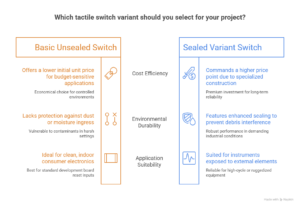
Compare quotations for equivalent parts. A basic unsealed switch and a sealed variant with different operating-life requirements are not the same purchase, even if their body dimensions match.
For bulk orders, confirm the minimum order quantity, GST, freight and delivery requirements. The useful comparison is the total cost of a suitable component, not just the lowest displayed unit price.
Why Buy from DDS International – Edzeal?
A supplier should make it easier to find the right component within your budget. DDS International – Edzeal offers wholesale buying options, a choice of tactile switch variants and assistance with component selection.
Competitive Wholesale Pricing
DDS International promotes competitive wholesale pricing for its switch range. Buyers can request a quotation based on the required variant and quantity rather than relying on a generic retail price.
For OEMs and resellers, discussing quantity-based pricing can help with purchase planning. Confirm the complete order cost, including applicable taxes and freight, before comparing offers.
A Choice of Sizes and Configurations
The DIP tactile switch range lists 6×6 options with different heights and 2-pin or 4-pin configurations. The wider range also includes surface-mount switches.
This choice allows you to look for a part that matches the existing design instead of changing the board or enclosure around an unsuitable component. Confirm availability for the exact variant you need.
Help with Product Selection
If you are unsure which switch to order, share the original part number, PCB dimensions or enclosure requirements with the sales team. A reference photograph can help start the discussion, but measurements and a datasheet should guide the final choice.
Where practical, evaluate a sample before approving a production quantity.
Related Components from One Supplier
DDS International also lists electronic switches, capacitors, resistors and sockets. Buyers with several component requirements can enquire about them together, which may simplify purchasing coordination.
For repeat orders, discuss quantities, approved part specifications and lead times in advance. Any proposed substitute should be checked before it is accepted.
Before Placing a Bulk Order
Confirm the following details before approving the purchase:
- Mounting style, footprint and terminal arrangement.
- Actuator height and fit inside the enclosure.
- Electrical ratings, operating force and life requirements.
- Sample performance with the final board and button cap.
- Part number, quantity, packaging and delivery terms.
A brief sample check can help catch fit or operating issues before they affect a larger batch.
Get a Quote for Your 6×6 Tactile Switch Requirement
The right switch should fit the board, work with the enclosure and meet the circuit’s requirements. Price matters, but it should be compared alongside these details.
Browse the DDS International – Edzeal DIP tactile switch range and share your required height, pin configuration, mounting style, quantity and delivery location.
Contact DDS International for current pricing and help selecting a suitable 6×6 tactile switch.
Frequently Asked Questions
Does a 6×6 Tactile Switch Stay ON After Pressing?
A common momentary version does not. Its contact opens when released. A circuit can use that brief press to toggle a device electronically.
Does a Tactile Switch Have Polarity?
A basic non-illuminated mechanical switch has no positive or negative polarity. Correct terminal pairing still matters. Illuminated versions may include separate LED connections with polarity requirements.
Can I Replace a Switch with a Different Height?
Only if the new height works with the existing enclosure and button cap. Matching the original height is usually the simplest starting point, along with checking the footprint, contact function and ratings.
How Can I Request Bulk Pricing from DDS International?
Send the required specification, quantity and delivery location through Edzeal’s contact page. Include a part number or datasheet if available, so the quotation matches the component you need.
What to read next
-

By EDZEAL | September 23, 2026
Crocodile Chimti 028 Black 50mm – Durable Electrical Test Clip | Edzeal
Crocodile Chimti 028 Black 50mm – A Reliable Solution for Secure Electrical Connections While working on electrical installations, testing and maintenance, it is important to use the right accessories along
-
By EDZEAL | June 6, 2026
Mylar Speakers 40mm Magnet, 29mm & 27mm Magnet – Complete Buying Guide
What Are Mylar Speakers? What Is a Mylar Speaker? A mylar speaker is a small, lightweight speaker that uses a thin plastic film — called Mylar — as its diaphragm.
-

By EDZEAL | May 30, 2026
Zener Diode vs Normal Diode: Which One is Better for Electronics?
When you build an electronic circuit, every component matters. Choosing the wrong diode can damage your circuit or make it stop working altogether. Two diodes often cause confusion — the