

SMD Resistors: Complete 2026 Guide to Sizes, Code Chart & Bulk Buying in India
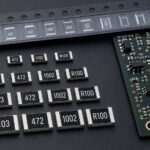
SMD resistors (Surface-Mount Device resistors) are among the most widely used passive components on modern printed circuit boards (PCBs). From 20W–25W fast mobile chargers and LED bulb drivers to home inverters, smart TVs, and electric vehicle battery packs, SMD resistors often make up 30% to 50% of the total components on a Bill of Materials (BOM).
Even though they look simple, selecting the wrong package size can overheat a compact board, and misreading a 3-digit or EIA-96 code can completely change a circuit’s output voltage. Choosing the wrong tolerance or buying poor-quality reels can also slow down factory assembly.
Whether you are repairing an electronic board or sourcing components in bulk for manufacturing, this guide by DDS International – Edzeal explains everything you need to check before ordering SMD resistors in India.
Quick Summary (Key Takeaways)
- Most Common Sizes: 0603 and 0805 are widely used in compact mobile chargers and consumer electronics, while 1206 (1/4 Watt) and 2512 (1 Watt) handle SMPS power supplies, LED drivers, and inverters.
- The 50% Power Safety Rule: Never run a chip resistor continuously at 100% of its rated power. Keep continuous heat load at 50% or less of rated wattage for long-term PCB life.
- 1% vs 5% Tolerance: Choose ±1% tolerance where accurate voltage matters (charger feedback dividers, battery cutoffs, and sensors). Use ±5% tolerance for indicator LEDs, pull-ups, and basic switching.
- Fast Code Check: On a resistor body, 103 = 10 kΩ, 472 = 4.7 kΩ, 1002 = 10 kΩ, 01C = 10 kΩ, and R10 = 0.10 Ω.
What Are SMD Resistors and How Do They Work?
An SMD resistor, also known as a chip resistor, is a compact rectangular component designed to sit flat and solder directly onto copper pads on the surface of a PCB. Unlike traditional through-hole resistors, it has no long metal wire leads and does not need drilled holes on the circuit board.
Inside a standard chip resistor is a high-purity ceramic base coated with a laser-trimmed resistive layer. A protective glass coating seals the top surface against moisture, while matte-tin metal terminations on both ends allow clean reflow soldering.
Electronics manufacturers across India prefer SMD resistors over wire-lead resistors for four practical reasons:
- Saves Up to 80% PCB Space: Products like mobile chargers, earbuds, and smart meters can be made much smaller because components mount on both sides of the board.
- Ready for Automated SMT Lines: Supplied in standardized 7-inch tape-and-reel rolls (typically 4,000 to 10,000 pieces per reel) for high-speed pick-and-place machines.
- Better High-Frequency Stability: Eliminating long wire leads reduces unwanted stray inductance in fast-switching power supplies.
- Lower Production Cost: Bulk reels lower per-unit component cost and save PCB hole-drilling expenses.
Common Types of SMD Resistors
Depending on the circuit requirement, five main types of SMD resistors are used in electronics manufacturing:
1. Thick-Film Chip Resistors
Thick-film resistors are the everyday industry standard used in more than 85% of electronic products, including trusted OEM brands such as HKR (Hong Kong Resistors Manufactory) supplied by Edzeal. They are cost-effective, operate from –55°C to +155°C, and are stocked in ±1% and ±5% tolerances across values from 1 Ω to 10 MΩ.
2. Thin-Film Precision Resistors
Thin-film resistors use a precision metallic layer to achieve very tight tolerances (0.1% or 0.05%) and low temperature drift (5 to 25 ppm/°C). They are chosen for testing instruments, medical equipment, and sensitive analog reference circuits.
3. Current-Sense (Low-Ohm / Shunt) Resistors
Built with very low resistance values (0.001 Ω up to 1.5 Ω) and higher wattage ratings, shunt resistors measure charging and load current inside LiFePO4 battery management systems (BMS), mobile chargers, and solar inverters — such as our 1.4 Ohm 1206 1% SMD Resistor.
4. SMD Resistor Arrays (Networks)
Resistor arrays combine 2, 4, or 8 matched isolated resistors inside a single multi-pin SMD package, saving board space around microcontrollers and memory buses.
5. Zero-Ohm Jumpers (Marked 000 or 0R0)
A zero-ohm resistor works like a tiny insulated wire bridge. Engineers use it on single-layer power boards to cross over copper tracks cleanly using the same automated pick-and-place machine.
SMD Resistor Package Sizes Chart (0402 to 2512)
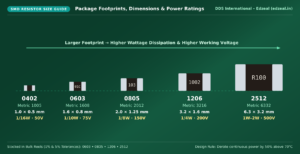
Sizes for SMD resistors are commonly written in 4-digit Imperial codes — such as 0603, 0805, 1206, and 2512 — on Indian BOMs. Larger size codes offer larger physical dimensions, higher wattage ratings, and higher working voltage limits.
| Package Size | Metric Code | Size in mm (L × W) | Power Rating | Max Working Voltage | Typical PCB Applications |
|---|---|---|---|---|---|
| 0201 | 0603 | 0.6 × 0.3 mm | 1/20 Watt | 25 V | Smartphones, TWS earbuds, dense RF modules |
| 0402 | 1005 | 1.0 × 0.5 mm | 1/16 Watt | 50 V | Smartwatches, compact IoT & camera boards |
| 0603 | 1608 | 1.6 × 0.8 mm | 1/10 Watt | 50–75 V | Fast mobile chargers (PD/PPS), MCU boards |
| 0805 | 2012 | 2.0 × 1.25 mm | 1/8 Watt | 150 V | General consumer electronics, audio, easy repair |
| 1206 | 3216 | 3.2 × 1.6 mm | 1/4 Watt | 200 V | SMPS power supplies, LED drivers, inverters |
| 1210 | 3225 | 3.2 × 2.5 mm | 1/3 – 1/2 Watt | 200 V | Surge protection & RC snubber networks |
| 2010 | 5025 | 5.0 × 2.5 mm | 3/4 Watt | 200–400 V | Power adapters, motor control drives |
| 2512 | 6332 | 6.3 × 3.2 mm | 1 – 2 Watt | 200–500 V | High-power shunts, EV battery BMS, bleeders |
Important Sizing Note: Some imported datasheets mention Metric codes instead of Imperial codes. Do not confuse Imperial 0603 (1.6 × 0.8 mm) with Metric 0603 (which is tiny 0201 size at 0.6 × 0.3 mm). Always check millimeter dimensions before placing a bulk order.
How to Read SMD Resistor Codes Easily
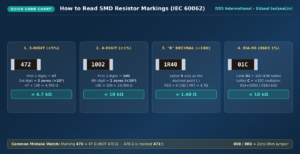
Because chip bodies are too small for color bands, manufacturers print alphanumeric codes following the international IEC 60062 resistor marking standard (note: tiny 0201 and 0402 chips are usually unmarked). Four simple systems cover almost every resistor on a PCB:
1. The 3-Digit System (Standard 5% Resistors)
The first two digits show the base number, and the third digit tells you how many zeros to add in Ohms:
- 470 = 47 with no zeros = 47 Ω (Note: 470 does NOT mean 470 Ω — 470 Ω is marked 471.)
- 102 = 10 with 2 zeros = 1,000 Ω = 1 kΩ
- 472 = 47 with 2 zeros = 4,700 Ω = 4.7 kΩ
- 103 = 10 with 3 zeros = 10,000 Ω = 10 kΩ
- 394 = 39 with 4 zeros = 390,000 Ω = 390 kΩ (such as our 390K 1206 5% SMD Resistor)
2. The 4-Digit System (1% Precision Resistors)
The first three digits give the base value, and the fourth digit tells you how many zeros to add:
- 1000 = 100 with no zeros = 100 Ω
- 1001 = 100 with 1 zero = 1,000 Ω = 1 kΩ
- 1002 = 100 with 2 zeros = 10,000 Ω = 10 kΩ
- 4702 = 470 with 2 zeros = 47,000 Ω = 47 kΩ
3. The “R” Decimal System (Values Below 10 Ohms)
For low resistance values, the letter R works as a decimal point: R10 = 0.10 Ω, 1R4 = 1.4 Ω, 4R7 = 4.7 Ω, and 30R0 = 30.0 Ω (see our 30R 1206 1% SMD Resistor).
4. The EIA-96 System (2 Digits + 1 Letter on 0603 1% Resistors)
Compact 0603 1% chips often use a two-digit lookup code (01 = 100, 18 = 150, 68 = 499) plus a multiplier letter (X = ×0.1, A = ×1, B = ×10, C = ×100, D = ×1,000). Therefore, 01A = 100 Ω, 01B = 1 kΩ, 01C = 10 kΩ, and 68X = 49.9 Ω.
| Printed Code | Marking System | Simple Calculation | Final Value |
|---|---|---|---|
| 000 or 0R0 | Jumper | Zero-resistance link | 0 Ω |
| R22 | R-Decimal | Decimal before 22 | 0.22 Ω |
| 470 | 3-Digit (5%) | 47 + no zeros | 47 Ω |
| 102 / 1001 | 3-Digit / 4-Digit | 1,000 Ohms | 1 kΩ |
| 103 / 1002 | 3-Digit / 4-Digit | 10,000 Ohms | 10 kΩ |
| 01B / 01C | EIA-96 (0603 1%) | 100 × 10 / 100 × 100 | 1 kΩ / 10 kΩ |
| 155 | 3-Digit (5%) | 15 + 5 zeros | 1.5 MΩ |
1% vs 5% Tolerance: Which One Should You Choose?
Tolerance describes how closely the actual component matches its printed resistance value:
- When to Pick ±1% Tolerance: Always choose 1% SMD resistors for SMPS voltage dividers, USB Type-C PD/PPS fast-charger detection, battery protection boards, and sensor circuits. Because bulk price differences between 1% and 5% reels are minimal today, many OEMs standardize on 1% reels across their factory floor.
- When to Pick ±5% Tolerance: 5% SMD resistors remain practical and economical for indicator LEDs, pull-up/pull-down lines, basic transistor switching, and capacitor discharge chains.
SMD Resistors vs Through-Hole Resistors
Many power boards — such as mobile chargers, LED drivers, and inverters — combine both styles on the same PCB. Compact SMD resistors sit on the bottom layer to run PWM control ICs, while larger through-hole fusible resistors sit on top to absorb AC mains surges. Explore both options in Edzeal’s Resistors Catalog.
| Feature | SMD Chip Resistors | Through-Hole (DIP / Axial) Resistors |
|---|---|---|
| Board Space | Very compact; mounts on both PCB sides | Larger size; requires drilled holes |
| Assembly Method | Automated pick-and-place + reflow soldering | Manual placement or wave soldering |
| Power Rating | Low to medium (0.05 W up to 2 W) | Medium to high (0.25 W up to 10 W+) |
| AC Mains Surge | Moderate (place 2–3 in series for high voltage) | Strong surge handling for AC input stages |
| Bulk Cost | Lowest per-piece cost on 5,000-piece reels | Higher component and PCB drilling cost |
What Should You Check Before Buying in Bulk?
Before locking your BOM for mass production, confirm these five practical points:
- Leave Double the Power Margin: If a circuit generates 0.10 Watts of heat, step up from a 1/10W (0603) chip to a 1/4W (1206) resistor so the board runs cool inside closed plastic housings.
- Check Working Voltage Limits: Never apply rectified 230V AC mains (~325V DC) across a single small 0603 resistor (50V limit). Connect two or three 1206 or 2512 resistors in series so the voltage divides safely.
- Standardize Package Sizes: Using mostly 0603 or 0805 across your design reduces SMT machine feeder changeovers.
- Source Related Components Together: Pair your SMD resistors with matching SMD Ceramic Capacitors (0603, 0805, 1206), SMD Power ICs, and Tactile Switches from one verified supplier.
- Test Samples Under Full Load: Validate board temperatures on pilot runs using Edzeal Sample & R&D Support before approving full production quantities.
Common Industrial Applications in India
- Mobile Chargers & Power Adapters: 20W/25W PD+PPS, SuperVOOC, and Quick Charge boards for voltage feedback, USB-C CC pins, and current sensing.
- SMPS, Inverters & Solar UPS Systems: MOSFET gate drive circuits, snubber networks, X-capacitor discharge bleeders, and overload sensing.
- LED Bulbs, Battens & Streetlight Drivers: Constant-current regulator loops and compact thermal control cards.
- EV Chargers & LiFePO4 Battery Packs: Cell-balancing bleed circuits and BMS current shunts.
- Home Appliances, Toys & Audio Boards: Sensor inputs, button pull-ups, audio preamplifiers, and display panels.
Why Buy SMD Resistors from DDS International – Edzeal?
Poor-quality reels with oxidized terminals or mixed resistance values can cause tombstoning during reflow and halt an SMT line. Since 2009, DDS International – Edzeal (Wazirpur Industrial Area, Delhi) has supplied OEMs, contract manufacturers, repair technicians, and wholesale buyers across India with reliable electronic components.
We maintain ready tape-and-reel inventory of genuine HKR and OEM-grade SMD resistors in 0603, 0805, 1206, and 2512 packages across ±1% and ±5% tolerances — alongside JWCO and Edzeal capacitors, HCW power ICs, switches, connectors, and battery cells.
- Order Online: Browse SMD Resistors Collection on Edzeal
- Bulk BOM Quotations: Submit a Bulk Enquiry
- Contact Sales Desk: 011-42463791 | +91 98999 30259 | info@ddsinternational.in
- Address: B-34 Group, Wazirpur Industrial Area, Delhi – 110052
Frequently Asked Questions (FAQs)
1. What is the difference between 0603, 0805, and 1206 SMD resistors?
The difference is physical size and wattage capacity. 0603 (1.6 × 0.8 mm) handles 1/10 Watt for compact PCBs like mobile chargers; 0805 (2.0 × 1.25 mm) handles 1/8 Watt for general electronics; and 1206 (3.2 × 1.6 mm) handles 1/4 Watt and up to 200V for SMPS, LED drivers, and inverters.
2. What do 103, 472, and 1002 mean on an SMD resistor?
103 equals 10 kΩ (10 followed by 3 zeros), and 472 equals 4.7 kΩ (47 followed by 2 zeros). 1002 is a 4-digit precision code meaning 100 followed by 2 zeros = 10,000 Ω, which is also 10 kΩ (while 1001 equals 1 kΩ).
3. Can I replace an 0805 resistor with a 1206 resistor during repair?
Yes, if the copper pads on the PCB are wide enough to solder it cleanly. Using a slightly higher power rating is safe, but never replace a larger 1206 power resistor with a smaller 0603 part without checking heat dissipation.
4. How many pieces come in one standard SMD resistor reel?
A standard 7-inch SMT reel typically contains 5,000 pieces for 0603, 0805, and 1206 sizes, 4,000 pieces for larger 2512 power chips, and 10,000 pieces for tiny 0402 packages.
5. Where can I buy genuine SMD resistors in bulk in India?
You can buy authentic HKR and OEM-grade SMD resistors online at edzeal.in or share your BOM with DDS International – Edzeal in Delhi for wholesale B2B pricing, GST invoicing, and fast pan-India delivery.
What to read next
-

By EDZEAL | October 6, 2026
Tactile Switch 6×6: Working, Pin Connections and Buying Guide
Tactile Switch 6×6: Working, Pin Connections and Buying Guide A replacement button can fit perfectly on a circuit board and still fail to work properly inside the device. Sometimes the
-

By EDZEAL | September 23, 2026
Crocodile Chimti 028 Black 50mm – Durable Electrical Test Clip | Edzeal
Crocodile Chimti 028 Black 50mm – A Reliable Solution for Secure Electrical Connections While working on electrical installations, testing and maintenance, it is important to use the right accessories along
-
By EDZEAL | June 6, 2026
Mylar Speakers 40mm Magnet, 29mm & 27mm Magnet – Complete Buying Guide
What Are Mylar Speakers? What Is a Mylar Speaker? A mylar speaker is a small, lightweight speaker that uses a thin plastic film — called Mylar — as its diaphragm.