
Zener Diode vs Normal Diode: Which One is Better for Electronics?

When you build an electronic circuit, every component matters. Choosing the wrong diode can damage your circuit or make it stop working altogether.
Two diodes often cause confusion — the Zener diode and the normal diode. They may look similar, but they work very differently.
Understanding the normal diode and Zener diode difference helps you pick the right one every time.

What Is a Zener Diode?
Zener Diode Definition
A Zener diode is a special type of diode designed to work in reverse bias without getting damaged.
Unlike a regular diode, it is built to handle a specific breakdown voltage. This zener diode definition is important — it was made to regulate voltage, not just block it.
Key point: A Zener diode keeps the voltage stable even when input voltage changes.
Zener Diode Diagram
Here is a simple breakdown of the Zener diode diagram:
Anode (A) ——|>|—— Cathode (K)
⌐ (bent ends on cathode = Zener symbol)
Terminals:
- Anode (A) — positive terminal
- Cathode (K) — negative terminal, identified by the bent Z-shaped line in the symbol
What makes it different visually:
- A normal diode symbol has a straight line at the cathode
- A Zener diode symbol has a bent or Z-shaped line at the cathode
The reverse breakdown region in the diagram shows where the Zener diode starts conducting in reverse — this is its working zone.
How Does a Zener Diode Work?
In forward bias, a Zener diode works just like a normal diode. Current flows from anode to cathode when voltage exceeds 0.6V–0.7V.
In reverse bias, something different happens. When the reverse voltage reaches a specific level called the Zener breakdown voltage, the diode starts conducting — in a controlled way.
This is the zener diode working principle — it allows reverse current at a fixed voltage without burning out.
Why does this matter?
- The voltage across the Zener stays constant
- This makes the Zener diode work as a voltage regulator
- It acts like a voltage “clamp” — holding the output steady

What Is a Normal Diode?
Normal Diode Definition
A normal diode is a two-terminal semiconductor device that allows current to flow in only one direction.
Think of it like a one-way valve for electricity. It lets normal diode current pass forward but blocks it in reverse.
Simple rule: Current flows → forward bias | Current blocked → reverse bias
How Does a Normal Diode Work?
In forward bias, the positive voltage is applied to the anode. The diode turns ON and normal diode current flows through the circuit.
In reverse bias, the positive voltage is applied to the cathode. The diode turns OFF and blocks current flow.
Example: A torch circuit uses a normal diode to make sure current only flows one way and doesn’t damage the battery.
If reverse voltage gets too high, the diode breaks down permanently — unlike a Zener diode, which is built for that.
Common Uses of a Normal Diode
Normal diodes are everywhere in basic electronics:
- Rectification — Converting AC (alternating current) to DC (direct current)
- Switching circuits — Turning current ON or OFF quickly
- Signal detection — Used in radios and communication devices
- Power supply circuits — Protecting components from reverse current
Zener Diode vs Normal Diode: Key Differences
Difference Table
| Feature | Zener Diode | Normal Diode |
| Working Principle | Voltage regulation via breakdown | One-way current flow |
| Bias Operation | Works in reverse bias | Works in forward bias only |
| Current Flow | Both forward and reverse (controlled) | Forward only |
| Voltage Handling | Fixed breakdown voltage | Blocks reverse voltage |
| Circuit Applications | Voltage regulators, protection circuits | Rectifiers, switching circuits |
| Cost | Slightly higher | Lower |
| Efficiency | High for voltage regulation | High for rectification |
| Symbol/Structure | Bent cathode line (Z-shape) | Straight cathode line |
This table clearly shows the normal diode and Zener diode difference at a glance.
Bottom line: Both are diodes, but they solve different problems.
Zener Diode Uses in Electronics
Where Is a Zener Diode Used?
The zener diode uses go beyond basic current control. Here is where it truly shines:
1. Voltage Regulation The most common use. The Zener diode as a voltage regulator keeps output voltage steady — even if input voltage fluctuates.
2. Overvoltage Protection It protects sensitive components by clamping excess voltage. If voltage spikes, the Zener absorbs it.
3. Voltage Stabilizers Used in power supply circuits to deliver a clean, stable voltage to microcontrollers and sensors.
4. Power Supplies Small power adapters and DC regulated supplies rely on Zener diodes to maintain consistent output.
Whenever you need the Zener diode as a voltage controller or protector — it is the right choice.
When Should You Choose a Normal Diode?
A normal diode is the better pick in these situations:
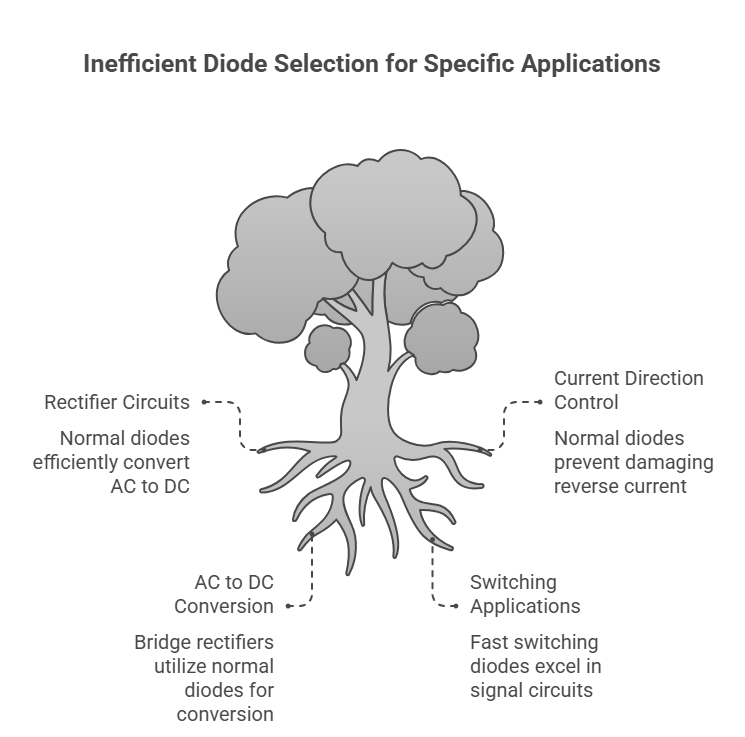
- Rectifier circuits — Converting AC mains power to usable DC voltage
- Current direction control — Preventing reverse current from damaging components
- AC to DC conversion — Bridge rectifier circuits use four normal diodes
- Switching applications — Fast switching diodes (like 1N4148) work great in signal circuits
If your goal is simply to control which direction current flows — a normal diode is all you need.
It is simpler, cheaper, and perfectly suited for these tasks.
Zener Diode vs Normal Diode: Which One Is Better?
Choose a Zener Diode If…
- Your circuit needs a stable, fixed voltage
- You want to protect components from voltage spikes
- You are building a voltage regulator or stabilizer
- You need reverse breakdown operation to be safe and controlled
Choose a Normal Diode If…
- You need to allow current in one direction only
- You are building a rectifier circuit (AC to DC)
- Your project involves signal switching or detection
- You want a low-cost, simple solution for basic circuits
Expert Recommendation
Here is the honest truth — there is no universally “better” diode.
The Zener diode vs Normal Diode debate is not about which one is superior. It is about which one fits your circuit’s needs.
- Need voltage regulation? → Zener diode wins
- Need current rectification? → Normal diode wins
A good electronics engineer does not choose the “best” component — they choose the right one.
Frequently Asked Questions (FAQ)
Q.1 What is the main difference between a Zener diode and a normal diode?
ANS. A normal diode allows current in one direction and blocks reverse voltage. A Zener diode is designed to operate in reverse bias at a specific breakdown voltage, making it ideal for voltage regulation. That is the core normal diode and Zener diode difference.
Q.2 Can a Zener diode replace a normal diode?
ANS. Technically yes — in forward bias, it works like a normal diode. But it is not recommended as a replacement. A Zener diode costs more and is designed for a different job. Use each diode for its intended purpose.
Q.3 Why is a Zener diode used in reverse bias?
ANS. Because that is where its special ability activates. In reverse bias, once voltage reaches the Zener breakdown voltage, it conducts steadily — keeping voltage constant. This is the core of zener diode working.
Q.4 Which diode is better for voltage regulation?
ANS. The Zener diode — without question. It is specifically built to regulate voltage. A normal diode cannot do this safely in reverse bias.
To Learn More About Zener Diode vs Normal Diode Visit Wikipedia
What to read next
-

By EDZEAL | June 6, 2026
Mylar Speakers 40mm Magnet, 29mm & 27mm Magnet – Complete Buying Guide
What Are Mylar Speakers? What Is a Mylar Speaker? A mylar speaker is a small, lightweight speaker that uses a thin plastic film — called Mylar — as its diaphragm.
-

By EDZEAL | May 18, 2026
What is a Glass Fuse Small & Fuse Holder? Types, Uses, Sizes & Buying Guide
What is a Glass Fuse Small? A small glass fuse is a tiny safety device used in electronic circuits. It protects your device from too much current flowing through it.
-

By EDZEAL | May 9, 2026
Potentiometer Explained: Uses, Types, Cost & Buying Guide for OEM Buyers
You have turned a volume knob. You have adjusted a fan speed. You have dimmed a light in your room. Every single time you did that — a potentiometer was