
No products in the cart.

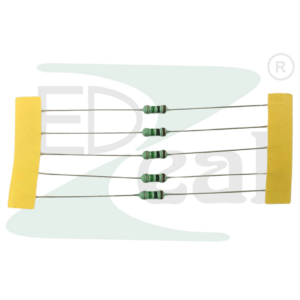
Resistance Value: 3.3E OHM
Power Rating: 1/4W
Material: Iron
Tolerance: ±5%
Packing Type: Tape Packing

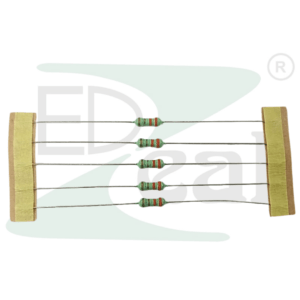
Resistance Value: 220 OHM
Power Rating: 1/4W
Material: Iron
Tolerance: ±5%
Packing Type: Tape Packing
₹0.08 (Excluding Tax)
The 220 Ohm ±5% 1/4W Through Hole Resistor is the single most popular resistor value in beginner and intermediate electronics — and for good reason. It sits in a perfect sweet spot: low enough resistance to allow visible, useful current flow, yet high enough to protect LEDs, GPIO pins, and transistors from the excessive current that causes immediate damage. Whether you are lighting your first LED on an Arduino, building a breadboard voltage divider, or designing a professional PCB, this is the resistor you reach for first.
Manufactured with a carbon film body, axial leads, and a flame-retardant coating, this component is built for reliable, repeatable performance across millions of insertions and long-term soldered assembly alike.
Key Technical Specifications
Resistance Value: 220 Ohm (220 Ω). Tolerance: ±5%. Power Rating: 1/4W (0.25 Watts). Type: Carbon Film, Through Hole (THT), Axial Lead. 4-Band Color Code: Red – Red – Brown – Gold. 5-Band Color Code: Red – Red – Black – Black – Gold. Maximum Operating Voltage: 350V. Operating Temperature: -55°C to +155°C. Temperature Coefficient: 0 / -850 ppm/°C. Lead Diameter: 0.55mm, copper-plated steel (24 AWG). Compliance: RoHS Compliant, Lead-Free.
Color Code — Fully Decoded for 4-Band and 5-Band
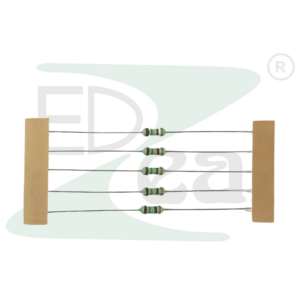
The standard 4-band color code for the 220 Ohm ±5% resistor is: Red – Red – Brown – Gold.
Reading left to right — Red represents the digit 2. The second Red also represents 2. Together they form the base number 22. Brown is the multiplier band, representing ×10. Multiplying 22 by 10 gives 220 Ohms exactly. The Gold tolerance band confirms ±5% accuracy.
This means any individual unit from this batch will measure between 209 Ohms and 231 Ohms — perfectly within specification for LED limiting, GPIO protection, pull-up/pull-down networks, and all general-purpose analog and digital circuit applications.
For 5-band precision versions: Red – Red – Black – Black – Gold, where the third band (Black) is the third significant digit (0), the fourth band (Black) is the ×1 multiplier, and Gold again indicates ±5% tolerance. Both versions resolve to the same nominal 220 Ω value.
The easy-to-read color bands printed on a tan/beige body allow rapid identification in any workshop without reaching for a multimeter — a key advantage during high-volume prototyping and assembly work.
Applications — Why Every Electronics Workbench Needs This Resistor
The 220 Ohm value is the most universally recommended current-limiting resistor for LEDs powered from 3.3V and 5V supplies — the two most common voltages in Arduino, Raspberry Pi, and ESP32 systems. At 5V with a standard red or green LED (forward voltage approximately 2.0V–2.2V), a 220 Ohm series resistor delivers approximately 12–14 mA of LED current — bright, safe, and well within the 20mA absolute maximum of virtually all standard LEDs.
Proven, real-world applications include: LED current limiting in 3.3V and 5V systems, Arduino and Raspberry Pi GPIO pin protection from short circuits and voltage spikes, push button input pull-up and pull-down networks, transistor base current limiting in switching and amplifier circuits, signal line series termination to damp ringing and reduce EMI during high-speed switching, NE555 timer circuit timing resistors, voltage divider networks for analog input signal scaling, breadboard and perf-board prototyping across all skill levels, sensor interface circuits and status indicator LEDs in PCB designs, and audio signal attenuation in low-impedance output stages.
Why Carbon Film Through Hole — The Right Component for the Job
Carbon film resistors offer the ideal balance of cost, noise performance, and electrical stability that makes them the industry standard for through-hole general-purpose design. Compared to older carbon composition types, carbon film generates significantly lower current noise — a measurable advantage in audio circuits, analog signal chains, and sensor interfaces where noise floor impacts performance.
The axial through-hole (THT) construction provides robust mechanical stability for both breadboard prototyping and permanently soldered PCB assemblies. The 0.55mm diameter copper-plated steel leads insert cleanly and repeatedly into solderless breadboards without bending, loosening, or creating poor contact — a common frustration with cheaper, thinner-lead alternatives. Solder joints are strong and consistent across both hand soldering and automated wave soldering processes.
The flame-retardant lacquer outer coating provides critical protection in enclosed PCB assemblies and consumer electronics where component heating is a design consideration.
Safe Operating Guidelines
While rated at 0.25W (1/4W), industry best practice for continuous-duty circuits is to derate to 50–70% of the rated wattage. For sustained operation, keep actual dissipation at or below 0.125W–0.175W. This extends the component’s operating lifespan significantly and maintains resistance stability under prolonged thermal stress.
For typical 220 Ohm applications — LED current limiting at 12–14mA gives approximately 0.03W dissipation — this resistor operates at only 12% of its rated power. It runs cool, stays stable, and will outlast the rest of your circuit comfortably.
The maximum safe current through this resistor at the 0.25W limit is approximately 33mA, calculated as I = √(P/R) = √(0.25/220) ≈ 0.033A. In LED circuits, typical operating current of 10–15mA provides substantial safety headroom.
Frequently Asked Questions — Answered
What is the color code of a 220 Ohm resistor? The 4-band color code is Red, Red, Brown, Gold. The 5-band version is Red, Red, Black, Black, Gold. Both indicate 220 Ohms with ±5% tolerance.
What is a 220 Ohm resistor used for? Its primary use is LED current limiting in 3.3V and 5V circuits (Arduino, Raspberry Pi, ESP32). It is also used for GPIO pin protection, transistor base biasing, pull-up/pull-down networks, and signal line protection.
What current does a 220 Ohm resistor allow at 5V? Using Ohm’s Law: I = V/R = 5/220 ≈ 22.7mA. With a red LED (2V forward voltage drop), it allows (5-2)/220 ≈ 13.6mA — ideal for safe, bright LED operation.
Is this the right resistor for an Arduino LED circuit? Yes — the 220 Ohm resistor is the most widely recommended value for standard 5mm LED circuits powered from Arduino 5V or 3.3V pins. It is found in virtually every beginner electronics kit globally.
Can I use 220 Ohm instead of 330 Ohm for LEDs? Yes. A 220 Ohm resistor will allow slightly more current (brighter LED) than a 330 Ohm. Both are safe choices for standard LEDs on 5V systems.
Is this resistor RoHS and lead-free compliant? Yes — fully RoHS compliant and manufactured lead-free.
There are no reviews yet.