
Resistance Value: 150K OHM
Power Rating: 1/4W
Material: Iron
Tolerance: ±5%
Packing Type: Tape Packing
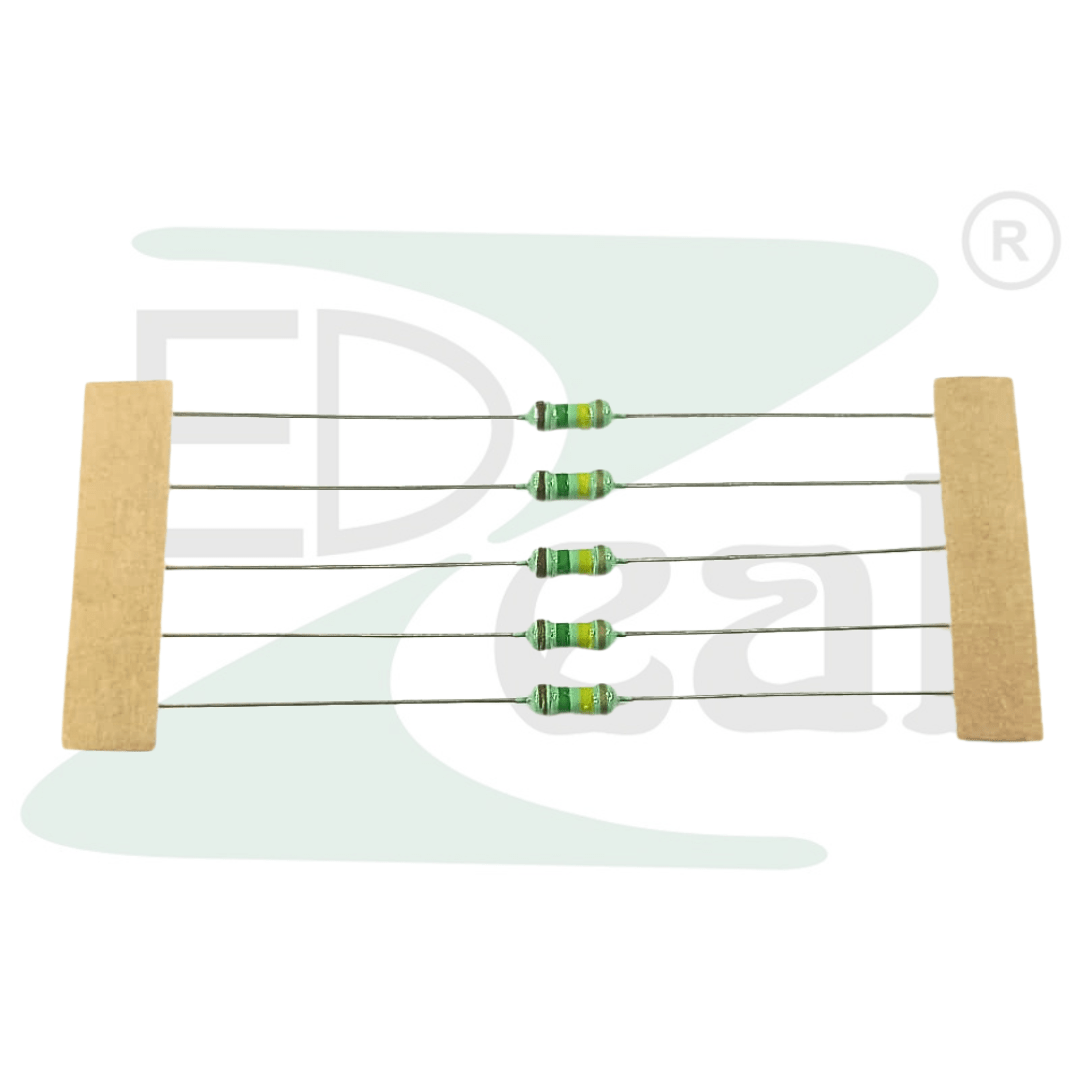
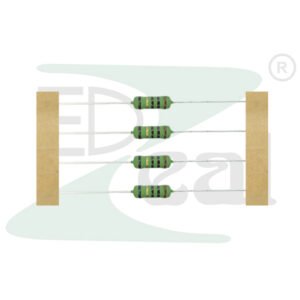
150K OHM ±5% 1/4W Through Hole Resistor — Carbon Film Axial
The 150K Ohm ±5% 1/4W Through Hole Resistor is a high-impedance general-purpose carbon film resistor built for precision signal-level applications in both professional PCB design and everyday electronics prototyping. With its reliable axial lead construction and flame-retardant coating, it delivers stable, consistent performance across a wide range of circuit environments.
Whether you are a student building your first sensor circuit, a hobbyist working on an Arduino project, or a professional PCB designer, this resistor is a must-have component in any electronics toolkit.
Key Specifications
- Resistance Value: 150K Ohm (150,000 Ω / 150 KΩ)
- Tolerance: ±5%
- Power Rating: 1/4W (0.25 Watts)
- Type: Carbon Film, Through Hole (THT), Axial Lead
- Color Code (5-Band): Brown – Green – Black – Orange – Gold
- Color Code (4-Band): Brown – Green – Yellow – Gold
- Maximum Operating Voltage: Up to 350V
- Operating Temperature Range: -55°C to +155°C
- Lead Diameter: 0.55mm (24 AWG), copper-plated steel
- Compliance: RoHS Compliant, Lead-Free
Color Code — Fully Decoded
4-Band Reading (most common): Brown (1) → Green (5) → Yellow (×10,000 multiplier) → Gold (±5% tolerance) = 150,000 Ohms = 150K Ω
5-Band Reading (precision variant): Brown (1) → Green (5) → Black (0) → Orange (×1,000 multiplier) → Gold (±5% tolerance) = 150,000 Ohms = 150K Ω
The clearly printed color bands allow quick, accurate identification in any workspace — no multimeter required for experienced builders. The gold tolerance band confirms this is a standard ±5% component, suitable for the vast majority of analog and digital circuit applications.
Where to Use This Resistor
The 150K Ohm value sits in the high-impedance range, making it particularly valuable in sensitive signal and analog circuit designs. Common and proven applications include:
Op-amp feedback and gain-setting networks, voltage divider circuits for analog signal scaling, high-impedance pull-up and pull-down networks, RC timing circuits with NE555 and similar IC timers, Arduino and Raspberry Pi analog input conditioning, audio preamplifier bias circuits, capacitor bleed resistors for safety discharge, transistor base biasing in high-gain amplifier stages, light-dependent resistor (LDR) and thermistor interface networks, and oscillator frequency-setting circuits.
Why Carbon Film Through Hole?
Carbon film resistors remain the gold standard for through-hole prototyping and general-purpose circuit design because they offer an excellent balance of electrical stability, low noise, and cost-efficiency. Unlike composition resistors, carbon film types produce significantly lower noise — a critical advantage in sensitive analog applications like audio circuits and sensor interfaces.
The axial through-hole (THT) design ensures solid, mechanical-grade stability during both manual and wave soldering. The 0.55mm copper-plated steel leads insert cleanly into solderless breadboards without bending, and solder joints remain strong and reliable throughout the product’s operational life.
The flame-retardant lacquer coating adds a critical safety margin in enclosed, high-temperature PCB environments — particularly relevant in industrial sensor boards and enclosed consumer electronics assemblies.
Safe Operating Guidelines
Although rated at 0.25W, industry best practice for continuous-duty circuits is to derate to 50–70% of the rated power. This means your circuit’s actual dissipation should ideally stay at or below 0.125W–0.175W, which significantly extends component lifespan and maintains resistance stability under thermal stress. For high-impedance circuits like voltage dividers and op-amp networks — where current through the 150K resistor is inherently very low — this is rarely a concern.
Frequently Searched — Answered Here
What is the color code of a 150K Ohm resistor? 4-band: Brown, Green, Yellow, Gold. 5-band: Brown, Green, Black, Orange, Gold.
What is a 150K resistor used for? High-impedance voltage dividers, op-amp feedback networks, RC timing circuits, Arduino analog input conditioning, and transistor bias circuits.
Is this resistor RoHS compliant? Yes — fully RoHS compliant and lead-free.
What is the difference between 150 Ohm and 150K Ohm? 150K Ohm equals 150,000 Ohms — one thousand times greater resistance. The 150K is used in high-impedance, low-current applications, while 150 Ohm is used in higher-current circuits like LED limiting.
Can I use this on a breadboard? Yes — the 0.55mm axial leads are optimized for repeated breadboard insertion without bending or damage.

There are no reviews yet.