
Types of Capacitors Explained (Comparison-Based)
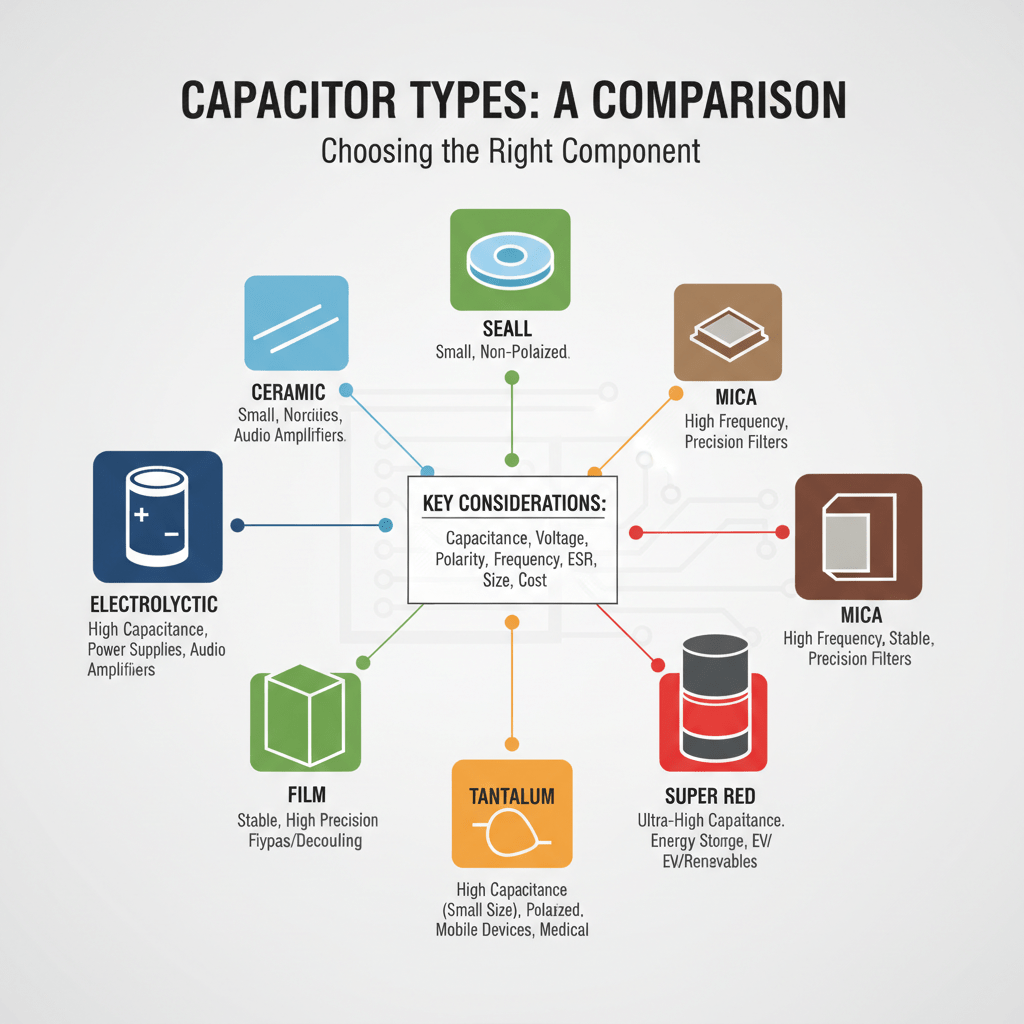
Not all capacitors are the same. Different jobs need different types. Choosing the wrong one can cause your circuit to fail — or perform poorly.
Here’s a clear breakdown of every major capacitor type you’ll come across.
Ceramic Capacitors
Ceramic capacitors are the most common type in modern electronics. They’re small, reliable, and work great at high frequencies.
They don’t have polarity — meaning you can place them either way in a circuit. That makes them beginner-friendly and mistake-proof.
SMD Ceramic Capacitors
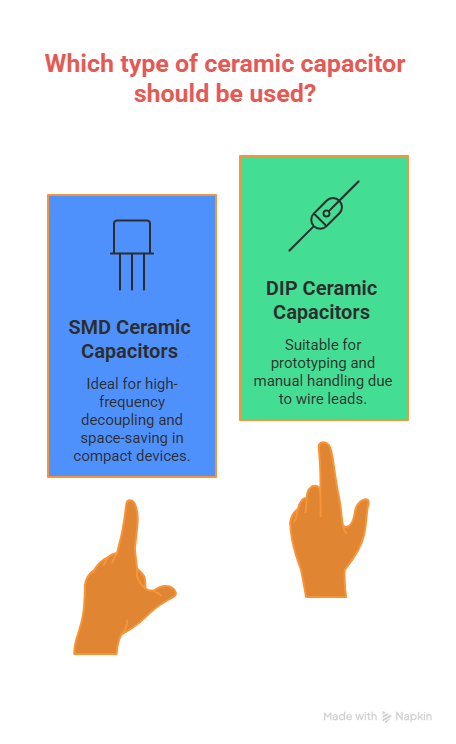
Buy SMD ceramic capacitors (Surface Mount Device) sit flat on the PCB surface. They’re tiny, which is why you’ll find them in smartphones, laptops, and compact circuit boards.
Key features:
- Great for high-frequency decoupling
- Save significant PCB space
- Suitable for automated manufacturing lines
- More cost-effective in mass production
Watch out: They can crack under mechanical stress — during bending, thermal shock, or rough handling on the board.
DIP Ceramic Capacitors
Buy DIP ceramic capacitors DVAN VS Buy DIP ceramic capacitors NDF have wire leads that go through holes in the PCB. These are easier to handle by hand and are common in prototyping and repair work.
Key features:
- Easy to insert and replace manually
- Great for learning and breadboard projects
- Slightly larger footprint than SMD versions
- Still perform well at high frequencies
Electrolytic Capacitors
- Buy Electrolytic capacitors DVAN
- Buy Electrolytic capacitors JWCO
- Buy Electrolytic capacitors EDZEAL
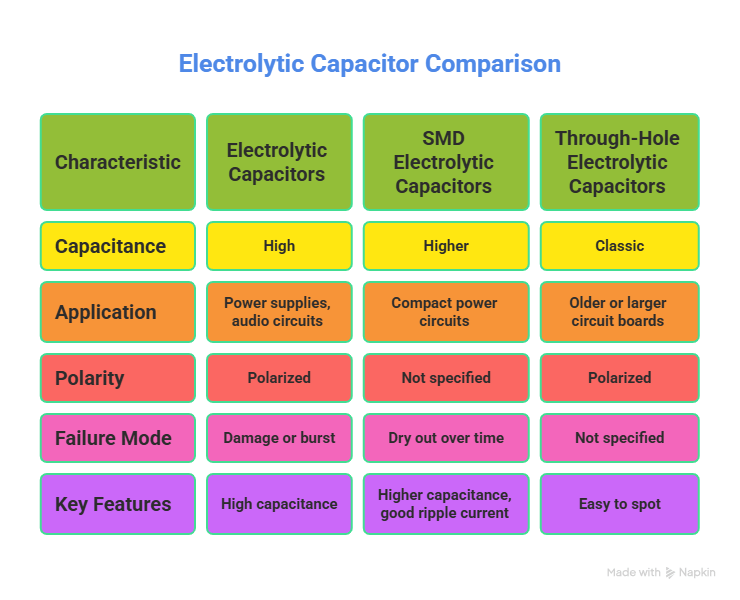
Store much more charge than ceramic types. If you need high capacitance — think power supplies and audio circuits — this is your go-to.
Important: These are polarized. The positive leg must connect to the positive side of the circuit. Getting it backwards can damage or even burst the capacitor.
SMD Electrolytic Capacitor
Bring the high-capacitance advantage into a surface-mount package. You’ll find these in compact power circuits where space is tight but bulk capacitance is still needed.
Key features:
- Higher capacitance in a smaller footprint
- Good ripple current handling
- Common in modern power management designs
Failure risk: These can dry out over time, especially in high-heat environments. When the internal electrolyte dries, capacitance drops and ESR rises.
Through-Hole Electrolytic Capacitors
These are the classic cylindrical capacitors you see on older or larger circuit boards. They’re easy to spot — usually black or blue cylinders with a stripe on the negative side.
Key features:
- Very high capacitance values available
- Strong ripple current handling
- Easy to test and replace
- Common in HVAC systems, motor drives, and power supplies
Solid Capacitors
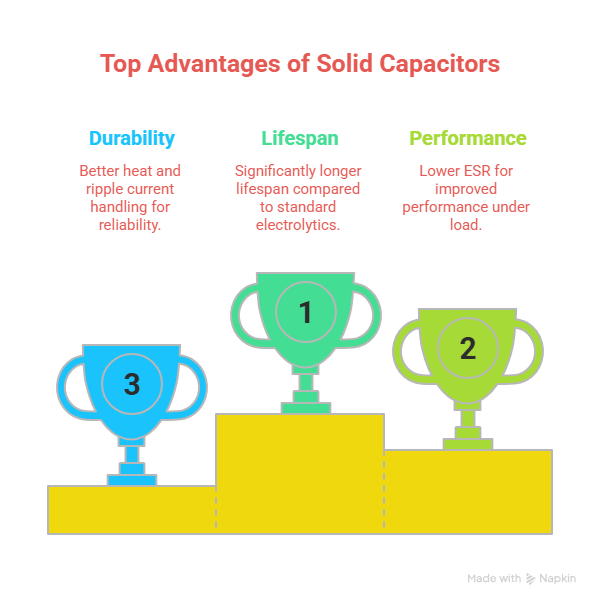
The upgraded version of standard electrolytics. Instead of liquid electrolyte, they use a solid conductive polymer — which means they last much longer.
Key features:
- Much longer lifespan (often 2x–5x standard electrolytics)
- Lower ESR for better performance under load
- Handle heat and ripple current far better
- Common in high-end motherboards and industrial electronics
Bottom line: If you’re designing something that needs to run reliably for years — solid capacitors are worth the extra cost.
High-Voltage Capacitors for Power Electronics – Trusted B2B Distributor EDZEAL.
Quick Comparison Table: SMD vs DIP Capacitors
| Feature | SMD | DIP (Through-Hole) |
| PCB Space | ✅ Compact | ❌ Larger footprint |
| Assembly | Automated (pick & place) | Manual or wave soldering |
| Cost (mass production) | ✅ Lower | ❌ Higher |
| Repairability | ❌ Harder to replace | ✅ Easy to swap |
| Prototyping | ❌ Tricky by hand | ✅ Breadboard-friendly |
| Thermal performance | Good | Good |
| Mechanical stress risk | Higher (ceramic crack risk) | Lower |
Choosing SMD makes sense when you’re producing at scale and need a compact board.
Choosing DIP makes sense when you’re prototyping, repairing, or building something that needs to be serviced later.
Leram more about Types of Capacitor on Wikipedia .
FAQs – Capacitors Explained (Beginner to Pro)
Got questions about capacitors? You’re not alone. Here are the most common questions — answered simply and clearly.

Q: What is the capacitor definition in electronics?
A capacitor is a component that stores electrical energy in an electric field. It’s made of two conductive plates separated by a dielectric (insulating) material. Think of it like a tiny, fast-charging battery that releases energy almost instantly.
Q: How do I define capacitance?
Capacitance is the ability of a component to store electric charge. It’s measured in Farads (F). In most circuits, you’ll work with microfarads (µF), nanofarads (nF), or picofarads (pF) — because a full Farad is enormous.
The basic formula is: Q = CV
- Q = charge stored
- C = capacitance
- V = voltage applied
Q: How does capacitor charging and discharging work?
When voltage is applied, the capacitor charges up — storing energy. When the source is removed, it discharges — releasing that energy back into the circuit.
The speed of charging and discharging depends on the RC time constant (resistance × capacitance). A larger resistor or capacitor means slower charging — and that’s actually useful in timing circuits.
Q: How do capacitors in series and parallel work?
Great question — and it’s the opposite of how resistors behave.
Capacitors in parallel:
- Capacitance adds up directly
- Total C = C1 + C2 + C3…
- Use parallel when you need more capacitance
Capacitors in series:
- Total capacitance decreases
- 1/C = 1/C1 + 1/C2 + 1/C3…
- Use series when you need to share voltage across capacitors
Q: What happens if the voltage rating is too low?
The capacitor can fail — sometimes dramatically. Always choose a capacitor with a voltage rating at least 20% higher than your circuit’s maximum voltage. This practice is called voltage derating, and it significantly extends component life.
Q: Can I replace an electrolytic capacitor with a ceramic one?
Sometimes — but not always. Ceramic capacitors work well for small capacitance values and high-frequency applications. But for large capacitance values (like 100µF or more), you’ll still need an electrolytic or solid capacitor.
Also remember — electrolytics are polarized, ceramics are not. Swapping types without checking polarity requirements can cause circuit damage.
Q: Why do capacitors fail?
The most common reasons are:
- Voltage overstress — running above the rated voltage
- Polarity reversal — connecting an electrolytic backwards
- Heat damage — drying out the internal electrolyte over time
- Ripple current overload — too much AC current causing internal heating
- Mechanical stress — ceramic capacitors cracking from board flex or thermal shock
Most failures are preventable with proper selection and circuit design.
Q: How do I test a capacitor?
You can test a capacitor using a digital multimeter with a capacitance setting or a dedicated component tester.
Basic steps:
- Discharge the capacitor fully before testing
- Set your meter to capacitance mode
- Touch probes to the capacitor leads (observe polarity for electrolytics)
- Compare the reading to the labeled value
A healthy capacitor reads close to its rated value. A reading of zero or near-zero usually means it’s dead.
Q: What are capacitors used for in HVAC systems?
In HVAC systems, capacitors are used to start and run electric motors — like compressors and fan motors. Without a run capacitor, the motor can’t maintain the phase shift it needs to keep spinning efficiently.
Failed HVAC capacitors are one of the most common causes of air conditioning breakdowns in summer.
Q: Where can I buy capacitors near me or online?
You can find capacitors at:
- Local electronics stores — great for small quantities and urgent needs
- Online distributors — like Digi-Key, Mouser, or LCSC for bulk or specialty types
- Direct from manufacturers or authorized suppliers like JWCO — ideal for sourcing quality SMD ceramic, SMD electrolytic, solid, and DIP capacitors in volume
If you’re sourcing for production or need HCV solutions, working with a trusted supplier ensures consistency and quality control.
Q: What’s the difference between capacitors and resistors?
Both control how current behaves in a circuit — but in different ways.
- Resistors limit current flow at all times
- Capacitors block DC current but allow AC to pass — and they store and release energy
Together, capacitors and resistors form RC circuits used for timing, filtering, and signal shaping. They’re two of the most fundamental building blocks in electronics.
What to read next
-

By EDZEAL | February 19, 2026
SMD Transistor Guide: Codes, Markings, BC547/BC847 Equivalents & TL431 vs TL432 Explained
What Is an SMD Transistor ? If you’ve ever looked at a modern circuit board and wondered what those tiny little components are — chances are, many of them are
-

By EDZEAL | November 17, 2025
How to Maintain Component Quality During Long-Term Storage
For OEMs, manufacturers, and industrial buyers, maintaining the quality of electronic components during long-term storage is crucial. Components like capacitors, resistors, connectors, ICs, switches, and transistors can degrade over time if not stored under proper conditions. This affects production reliability, product performance, and overall cost efficiency
-
By EDZEAL | November 12, 2025
How Price Fluctuations in Electronic Components Impact OEM Production Planning
In the fast-moving electronics industry, price stability is a rare luxury. Component prices can fluctuate due to global shortages, material costs, currency shifts, and geopolitical factors. For OEMs, these price changes can significantly affect production planning, costing, and delivery schedules. Understanding how to manage and respond to these fluctuations is critical to maintaining profitability and operational stability.