
SMD Transistor Guide: Codes, Markings, BC547/BC847 Equivalents & TL431 vs TL432 Explained
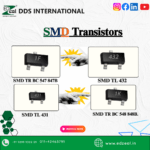
What Is an SMD Transistor ?
If you’ve ever looked at a modern circuit board and wondered what those tiny little components are — chances are, many of them are SMD transistors.
SMD stands for Surface Mount Device. It simply means the component sits flat on the surface of the board instead of going through holes like older parts do.
Traditional transistors (called through-hole types) have long wire legs that poke through the PCB. SMD transistors are much smaller and get soldered directly onto pads on the board’s surface. This makes them perfect for compact, modern electronics.
The Basic Structure: Base, Emitter, and Collector
Every transistor — SMD or not — has three terminals:
- Base (B) — The control pin. A small signal here switches the transistor on or off.
- Collector (C) — Current flows into this pin (for NPN types).
- Emitter (E) — Current flows out of this pin to the ground.
Think of the base like a tap handle. Turn it slightly, and you control a much bigger flow between the collector and emitter.
Understanding what collector, emitter, and base do is the foundation of working with any transistor — SMD or through-hole.
Why Are SMD Transistors So Common Now?
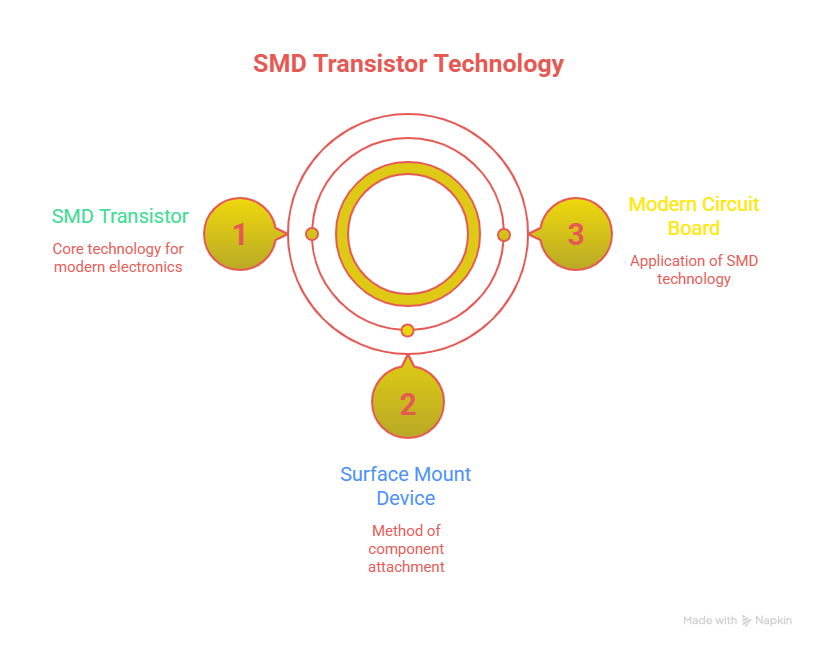
Manufacturers switched to SMD for good reasons:
- They’re much smaller, so more components fit on one board
- They’re faster to assemble using automated pick-and-place machines
- They perform just as well as through-hole types in most circuits
- They help reduce the overall size and weight of electronic products
You’ll find them in smartphones, LED drivers, power supplies, audio equipment, and almost every piece of modern consumer electronics.
Common SMD Transistor Sizes and Packages
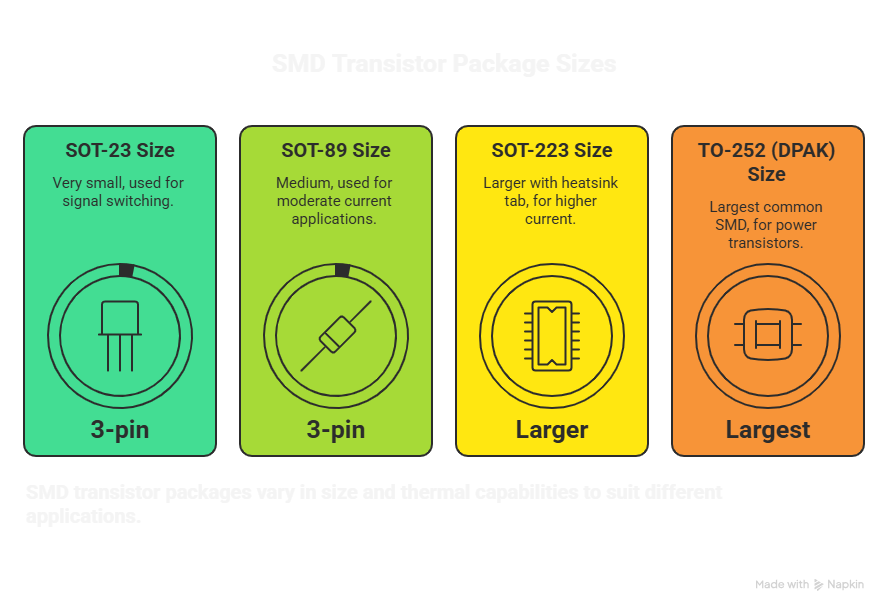
SMD come in several standard package sizes. The most common ones you’ll encounter are:
| Package | Size | Typical Use |
| SOT-23 | Very small (3-pin) | Signal switching, low power |
| SOT-89 | Medium (3-pin) | Moderate current applications |
| SOT-223 | Larger, with heatsink tab | Higher current, better thermal handling |
| TO-252 (DPAK) | Largest common SMD | Power transistors, voltage regulators |
The smaller the package, the less heat it can handle — so always check the datasheet before swapping packages.
For most beginners exploring an smd list, the SOT-23 is what you’ll see most often. It’s tiny, usually marked with a short 2–3 character code, and used everywhere in signal-level circuits.
Understanding SMD Transistor Codes & Marking Systems
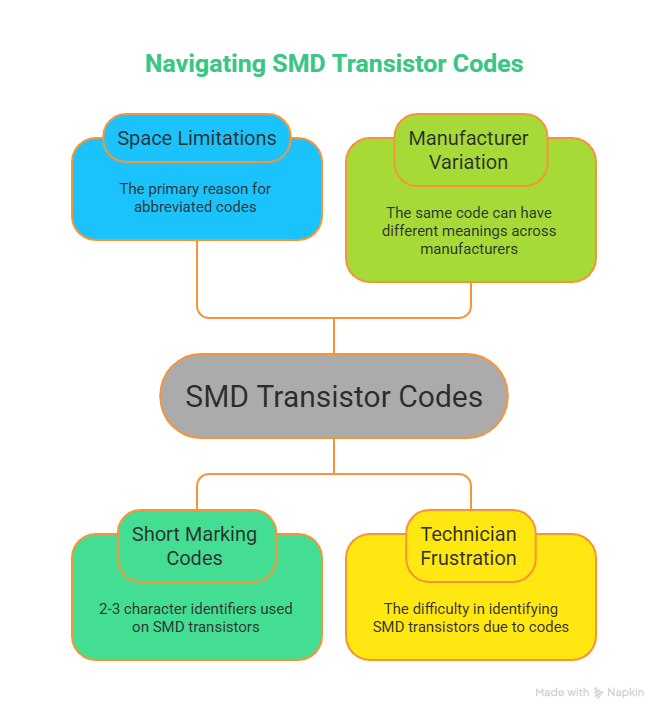
Here’s something that confuses almost everyone who starts working with SMD components: there’s no room to print a full part number on a tiny SMD transistor.
A regular through-hole transistor like a BC547 has its full name printed right on the body. Easy. But an SMD in a SOT-23 package is barely 3mm wide. So manufacturers use short marking codes instead — sometimes just 2 or 3 characters.
That short code is your only clue to identifying the part.
Why Codes Get Abbreviated
The marking system exists purely because of space limitations. A code like “1AM” or “BR” might represent a well-known transistor, but you’d never guess it just by looking.
This is why so many technicians find SMD identification frustrating at first — the same code can even mean different things from different manufacturers.
How to Decode an SMD Transistor Marking Code
Here’s a simple workflow that works most of the time:
- Identify the package type — Is it SOT-23? SOT-89? SOT-223?
- Note the marking code exactly — Letter case matters. “BR” and “Br” can be different parts.
- Cross-reference a database or app — Use an smd transistor code app like Alltransistors, SMD Codebook, or search the marking on sites like smd.yooneed.one
- Pull up the datasheet — Confirm the pinout, voltage ratings, and gain before using the part
Never assume a code match without checking the datasheet. Different manufacturers reuse codes for completely different components.
The “BR” Marking Code Example
The smd transistor marking code BR is a common example of how this gets tricky.
The code “BR” on a SOT-23 package often refers to the BC547 — a general-purpose NPN transistor. But depending on the manufacturer, it could also refer to other parts entirely.
This is exactly why the workflow above matters. One wrong assumption and you’ve installed the wrong transistor.
Tools and Apps for Decoding SMD Codes
You don’t have to memorize anything. Use these resources:
- SMD Codebook app (Android/iOS) — Searchable database of thousands of codes
- Alltransistors.com — Web-based lookup with datasheet links
- Manufacturer marking guides — NXP, ON Semiconductor, and others publish their own marking tables
- Google search — Searching “SMD marking code [your code] SOT-23 transistor” often gets fast results
The smd transistor code app approach is the fastest method when you’re on the bench with an unknown part in hand.
Complete SMD Transistor Package & Size Guide
Not all SMD are the same size — and that size difference matters more than most beginners realize.
The package determines how much power the transistor can handle, how much heat it can shed, and what kind of circuit it belongs in.
SOT-23 — The Most Common Signal Transistor Package
SOT-23 is the package you’ll see most often on the smd transistor list for general electronics work.
- Very small — about 3mm × 1.75mm
- 3 pins (or sometimes 6 for dual transistors)
- Handles low current — typically up to 100–200mA
- Great for switching and signal amplification
- Not suitable for high-power applications
Most SMD equivalents of popular through-hole signal transistors (like BC847 for BC547) come in SOT-23.
SOT-89 — The Middle Ground
SOT-89 is bigger than SOT-23 and can handle more current and heat.
- Better thermal performance due to larger die attach area
- Handles currents up to around 1.5A depending on part
- Used in voltage regulators and medium-power circuits
If you need a bit more grunt than SOT-23 can offer but don’t want to jump to a full power package, SOT-89 is often the answer.
SOT-223 — Higher Power with a Heatsink Tab
This package includes a large metal tab on one side that acts as a heatsink.
- Can dissipate significantly more heat
- Commonly used for LDO voltage regulators and higher-current transistors
- The tab is also an electrical connection (usually collector)
Always check if the tab needs to be electrically isolated from your heatsink in SOT-223 designs.
TO-252 (DPAK) — The Power Package
TO-252, often called DPAK, is used for real power transistors and MOSFETs.
- Largest common SMD transistor package
- Handles high currents and voltages
- Has a large tab for heat dissipation
- Found in motor drivers, power regulators, and switching circuits
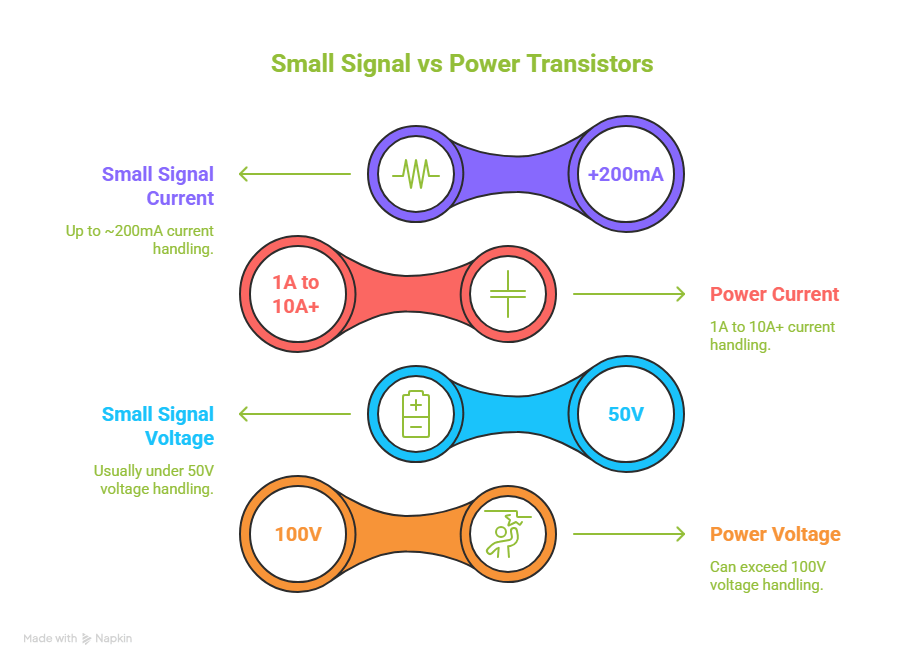
Signal vs Power Transistors — What’s the Real Difference?
| Feature | Small Signal (SOT-23) | Power (DPAK/SOT-223) |
| Current | Up to ~200mA | 1A to 10A+ |
| Voltage | Usually under 50V | Can exceed 100V |
| Heat handling | Minimal | Designed for thermal management |
| Typical use | Logic, audio, switching | Motor control, SMPS, regulators |
Understanding smd sizes isn’t just academic — picking the wrong package for a circuit can mean a burnt component within seconds of power-on.
Through-Hole vs SMD Transistor (BC547 → BC548 Conversion Explained)
The BC547 is one of the most popular transistors ever made. If you’ve been in electronics for any time, you’ve used one.
The SMD equivalent of the BC547 is the BC548. Same basic function, same family — but packaged for surface mount use.
This type of direct conversion is common when redesigning a through-hole circuit for modern SMD production.
BC547 → BC847 and BC548 → BC848 Comparison
| Feature | BC547 (Through-Hole) | BC847 (SMD SOT-23) |
| Type | NPN | NPN |
| V_CEO (max) | 45V | 45V |
| I_C (max) | 100mA | 100mA |
| Package | TO-92 | SOT-23 |
| Gain Group A | hFE 110–220 | hFE 110–220 |
| Gain Group B | hFE 200–450 | hFE 200–450 |
| Gain Group C | hFE 420–800 | hFE 420–800 |
| Feature | BC548 (Through-Hole) | BC848 (SMD SOT-23) |
| Type | NPN | NPN |
| V_CEO (max) | 30V | 30V |
| I_C (max) | 100mA | 100mA |
| Package | TO-92 | SOT-23 |
The main electrical specs are nearly identical — the difference is purely physical packaging.
Critical Warning: The Pinout Is Different
This catches beginners every single time. The pin order on a BC547 (TO-92) is NOT the same as on a BC847 (SOT-23).
- BC547 (TO-92) pinout (flat face toward you, left to right): C – B – E
- BC847 (SOT-23) pinout: B – E – C (varies — always check the datasheet)
If you swap these without checking, the transistor will either not work or get damaged immediately.
Always verify the pinout from the manufacturer’s datasheet — don’t rely on memory or assumed equivalence for pin order.
Gain Groups: A, B, and C
Both the BC547/BC847 and BC548/BC848 come in three gain variants:
- A suffix — Lower gain range
- B suffix — Medium gain (most common, good general-purpose choice)
- C suffix — Higher gain range
For most circuits, the B variant (BC847B or BC848B) is the best default choice unless the design specifically needs high or low gain.
The SMD TR BC 547 847B and SMD TR BC 548 848B designations you’ll see in component lists simply refer to these SMD equivalents in the B gain group.
SMD TL431 vs TL432 – Key Differences & Applications
The TL431 and TL432 are not transistors — but they look like one in a SOT-23 package, and they get confused with transistors constantly.
Both are adjustable shunt voltage regulators. They’re used to create precise voltage references and feedback circuits, especially in power supplies.
What Is the TL431?
The SMD TL431 is a three-terminal adjustable shunt regulator. It works like a programmable zener diode.
- Adjustable reference voltage from 2.5V to 36V
- Used heavily in SMPS feedback circuits
- Controls the output voltage of switching power supplies
- Also used as a voltage reference in precision circuits
You’ll find TL431s in almost every phone charger, laptop adapter, and LED driver power supply ever made.
What Is the TL432?
The SMD TL432 is essentially the same device as the TL431 — same internal circuit, same function.
The difference is the pin configuration.
The pins are arranged differently, which matters a lot when placing the component on a PCB.
The TL432 was created to offer a pinout that’s more convenient for certain PCB layouts. Electrically, they’re interchangeable — but you cannot swap them on a board without checking the footprint and pinout first.
Common Applications
Both parts are used in:
- SMPS feedback loops — Comparing output voltage to a reference and adjusting the PWM controller
- Precision voltage references — Providing a stable 2.5V or other voltage for ADCs and sensors
- Battery protection circuits — Triggering cutoff at a set voltage threshold
- LED constant-current drivers — Maintaining stable current through LEDs
Package Options
Both the TL431 and TL432 come in:
- SOT-23 — Smallest, most common for modern compact designs
- SOT-89 — Slightly larger, better thermal handling
- TO-92 — Through-hole version (older designs)
Remember: these are voltage regulators, not transistors. But because they look identical to a transistor in SOT-23 format and have three pins, they get misidentified constantly during fault diagnosis.
Always check the marking code and cross-reference it before assuming a three-pin SOT-23 part is a transistor.
How to Test and Identify Unknown SMD Transistor
Found an unknown SMD component on a board and have no idea what it is? Here’s a practical step-by-step approach that actually works.
Step 1: Visual Inspection
Start by just looking at the component carefully.
- What shape is it? 3 pins = likely transistor, regulator, or diode. More pins = probably an IC.
- What’s the package? SOT-23, SOT-89, SOT-223?
- Is there a marking code on top?
Write down the marking code exactly as you see it — including letter case.
Step 2: Decode the Marking Code
Take that code and look it up using:
- An smd transistor code app on your phone
- Online databases like smd.yooneed.one or alltransistors.com
- The manufacturer’s marking guide if you know the brand
Cross-reference the package type with the code. The same code on a SOT-23 vs SOT-89 may refer to different parts.
Step 3: Use a Multimeter in Diode Test Mode
If you can’t identify it by code, you can test it.
Set your multimeter to diode test mode (the symbol that looks like a triangle with a line).
For an NPN transistor:
- Place the red probe on the Base
- Touch black probe to Collector → should show ~0.6–0.7V
- Touch black probe to Emitter → should show ~0.6–0.7V
- Reverse probes → should show OL (no conduction)
This confirms it’s a transistor and helps identify the Base pin.
Finding the Collector and Emitter
Once you know the Base:
- The Collector-to-Emitter reading (Base floating) should show very high resistance in both directions
- With a component tester (like the M328 or TC1 style testers), you can identify all three pins automatically
A dedicated component tester is worth buying if you work with SMD parts regularly. It identifies transistors, their pinout, type (NPN/PNP), and gain in about 3 seconds.
Important: Be Careful with In-Circuit Measurements
Testing a transistor while it’s still soldered on the board can give you completely wrong readings.
- Other components connected to the same pins affect your multimeter readings
- A resistor in parallel with the Base-Emitter junction can make a good transistor look faulty
- When in doubt, remove the component from the board before testing
Understanding the smd transistor base emitter collector arrangement is what makes the difference between accurate testing and chasing a fault that doesn’t exist.
SMD Transistor vs Other Small SMD Components (Avoid Misidentification)
This is where a lot of people get confused — especially when looking at a dense PCB for the first time.
Not every small black SMD component is a transistor.
In fact, on most modern boards, actual discrete transistors are becoming rarer. The majority of small SMD components are capacitors, resistors, or diodes.
What Those Small Dots and Rectangles Usually Are
When you see tiny components clustered around ICs and processor chips:
- Two-pad rectangular components — Almost always resistors or capacitors (0402, 0603, 0805 sizes)
- Small two-pin components that look like diodes — Could be diodes, small inductors, or ferrite beads
- Three-pin SOT-23 components — Could be transistors, but also MOSFETs, voltage references (TL431), LDOs, or ESD protection devices
Just because it has three pins doesn’t automatically make it a transistor.
How Bypass Capacitors Differ from Transistors
Bypass capacitors are everywhere on PCBs — they filter noise on power supply lines.
- They have two terminals, not three
- They have no marking code (or a very small one that indicates value, not part number)
- They pass AC signals and block DC
Transistors always have three terminals and a marking code. If you count two pads, it’s not a transistor.
Why Discrete Transistors Are Less Common on Dense Boards
Modern circuit design increasingly replaces individual transistors with:
- Integrated circuits (ICs) that contain dozens of transistors internally
- Gate driver ICs
- Motor driver chips
- Power management ICs
So while the smd list is long, you may only find a handful of discrete transistors on a complex board — surrounded by hundreds of passives.
Don’t assume every component you can’t immediately identify is a transistor. Slow down, check the pin count, look for a marking code, and use a database before drawing conclusions.
Buying SMD Transistors Online (Sri Lanka & Global Markets)
Whether you’re restocking your bench or sourcing parts for a repair job, buying SMD requires a little more care than picking up through-hole parts.
The main challenge is avoiding counterfeit or mismarked components — which is a real problem, especially with popular parts.
Where to Buy SMD Transistor
In Sri Lanka, common options include:
- Local electronics stores in Pettah (Colombo) and other main cities — good for common parts like BC847, BC848
- Local component suppliers who stock brand-name parts from distributors
- Online via local platforms — check seller ratings carefully
Globally, reliable sources include:
- Mouser, DigiKey, LCSC — Authorized distributors with genuine parts and full datasheets
- AliExpress — Wide selection but higher counterfeit risk; buy from highly rated stores with verified reviews
- Amazon — Convenient but verify the seller is an authorized distributor
For critical applications like SMPS feedback circuits, always buy from authorized distributors even if the price is higher.
SMD Transistor Price in Sri Lanka
Pricing varies depending on type and quantity, but general ranges for the smd price in Sri Lanka:
- Common signal transistors (BC847, BC848) — Very affordable in small quantities, often sold in strips of 10–50
- Power transistors (SOT-223, DPAK types) — Moderately priced, more expensive per unit
- Bulk purchases — Significantly cheaper per unit; useful if you repair equipment regularly
Prices fluctuate with import costs and exchange rates, so check current listings for accurate figures.
How to Avoid Counterfeit Parts
This is the most important buying tip:
- Buy from authorized distributors whenever possible
- Check the marking code when parts arrive — compare to the datasheet
- Test the part before installing in a critical circuit
- Avoid suspiciously cheap pricing on high-demand parts
Always Check the Datasheet Before Ordering
Even if you’re confident about the part number, pull up the datasheet before ordering.
- Confirm the package type matches your PCB footprint
- Verify voltage and current ratings meet your needs
- Check the pinout — especially if ordering an SMD version of a through-hole part
For smd transistor online purchase decisions, the datasheet is your best protection against ordering the wrong component — or a counterfeit one that only pretends to meet spec.
Learn More on Wikipedia
Electronic Components Online Store in India – Shop Near You or Order Online From Our Website. Browse Our Wide Range of Electronic Components Online – Shop with Ease in India Edzeal .
What to read next
-
By EDZEAL | November 17, 2025
How to Maintain Component Quality During Long-Term Storage
For OEMs, manufacturers, and industrial buyers, maintaining the quality of electronic components during long-term storage is crucial. Components like capacitors, resistors, connectors, ICs, switches, and transistors can degrade over time if not stored under proper conditions. This affects production reliability, product performance, and overall cost efficiency
-
By EDZEAL | November 12, 2025
How Price Fluctuations in Electronic Components Impact OEM Production Planning
In the fast-moving electronics industry, price stability is a rare luxury. Component prices can fluctuate due to global shortages, material costs, currency shifts, and geopolitical factors. For OEMs, these price changes can significantly affect production planning, costing, and delivery schedules. Understanding how to manage and respond to these fluctuations is critical to maintaining profitability and operational stability.
-

By EDZEAL | November 10, 2025
How AI and Automation Are Changing the Electronics Industry
The electronics industry is undergoing a major transformation. Artificial Intelligence (AI) and automation are no longer futuristic concepts — they are driving real change across manufacturing, design, testing, and supply chain management. For OEMs and industrial manufacturers, adopting these technologies means faster production, fewer errors, and improved product quality.