Resistors – Types, Working, Color Code, Series & Parallel Explained

What is a Resistor? (Resistors Meaning & Definition)
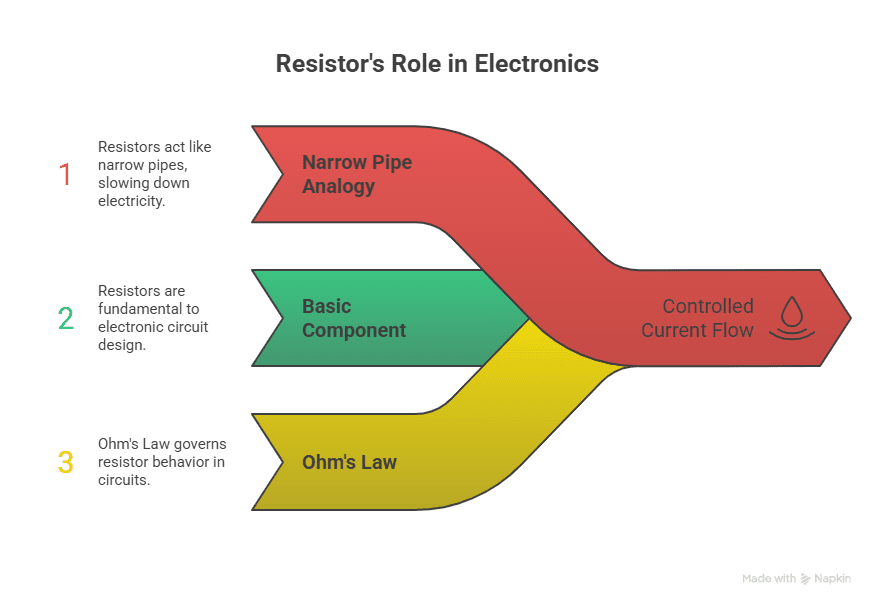
A resistor is an electronic component that controls (resists) the flow of electric current in a circuit.
Think of it like a narrow pipe in a water system — it slows down the flow. In electronics, a resistor slows down the flow of electricity.
Resistors are one of the most basic and important components in any electronic circuit.
Resistor definition in simple words: A resistor is a two-terminal passive component that reduces current and drops voltage in a circuit.
- Used in every electronic device — phones, TVs, computers, Arduino boards
- Measured in Ohms (Ω)
- Works on Ohm’s Law: V = I × R
Types of Resistor
Resistor come in many types. The two most common types used in everyday circuits are:
- SMD Resistors (Surface Mount)
- Through Hole (DIP) Resistors
Let’s understand both clearly.
SMD Resistors
SMD stands for Surface Mount Device. These are tiny resistor that sit directly on the surface of a PCB (printed circuit board).
They are used in modern compact electronics like smartphones, laptops, and smartwatches.
Key features of SMD Resistors:
- Very small in size — often smaller than a grain of rice
- Soldered directly onto the PCB surface
- No holes needed on the board
- Available in standard sizes: 0402, 0603, 0805, 1206
- Suitable for automated machine assembly
When to use SMD Resistors:
- When you need a small, lightweight circuit
- In mass-produced electronics
- When working with modern PCB designs
Through Hole (DIP) Resistors
Through Hole resistor (also called DIP resistor) have two wire leads that go through holes in a PCB.
These are the classic resistor you see in school lab kits and beginner electronics projects.
Key features of Through Hole Resistor:
- Have metal leads (legs) on both ends
- Inserted through PCB holes and soldered from the bottom
- Larger and easier to handle by hand
- Color bands printed on them to show resistance value
- Available in standard power ratings: ¼W, ½W, 1W, 2W
When to use Through Hole Resistor:
- In prototyping and breadboard projects
- In school/college experiments
- When doing manual soldering
- In high-power circuits that need better heat handling
Complete Comparison – SMD vs Through-Hole Resistors
Here’s a quick side-by-side comparison to help you choose the right one:
| Feature | SMD Resistor | Through Hole (DIP) Resistor |
| Size | Very small | Larger |
| Mounting | Surface of PCB | Through holes in PCB |
| Soldering | Machine preferred | Easy by hand |
| Best for | Production PCBs | Prototyping, experiments |
| Readability | Printed code (e.g., 103) | Color bands |
| Cost | Slightly cheaper in bulk | Slightly more expensive |
| Heat handling | Lower | Better |
| Beginner-friendly | ❌ Difficult | ✅ Easy |
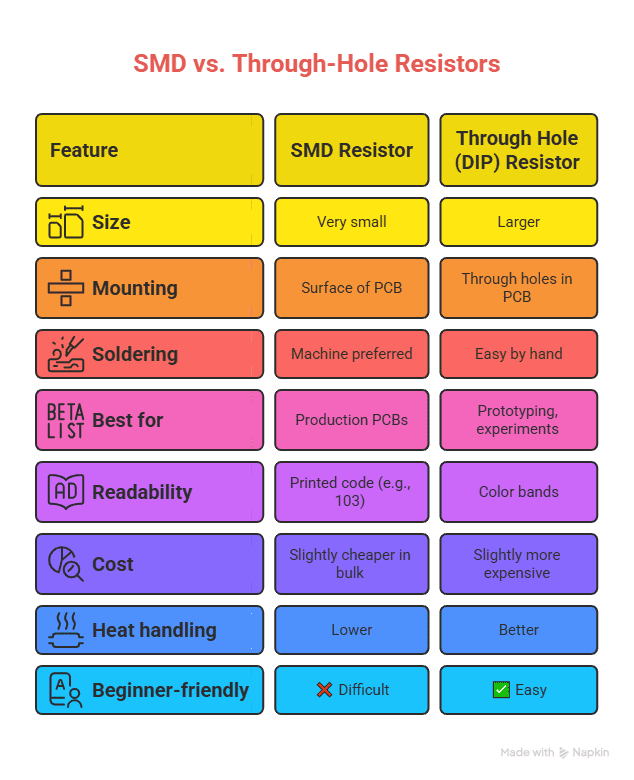
Bottom line: Use SMD for final PCB designs. Use Through Hole for learning, testing, and prototyping.
Resistor Color Code Explained
Through hole resistor use colored bands to show their resistance value. You just need to read the colors in order.
This is called the Resistor Color Code system.
The Color Code Table (4-Band Resistor):
| Color | Digit | Multiplier |
| Black | 0 | ×1 |
| Brown | 1 | ×10 |
| Red | 2 | ×100 |
| Orange | 3 | ×1K |
| Yellow | 4 | ×10K |
| Green | 5 | ×100K |
| Blue | 6 | ×1M |
| Violet | 7 | ×10M |
| Grey | 8 | — |
| White | 9 | — |
| Gold | — | ×0.1 (±5%) |
| Silver | — | ×0.01 (±10%) |
Example: How to read a resistor color code
Bands: Brown – Black – Red – Gold
- Brown = 1
- Black = 0
- Red = ×100
- Gold = ±5% tolerance
Value = 10 × 100 = 1000 Ω = 1 kΩ ±5%
Tip: A popular memory trick — “BB ROY of Great Britain has a Very Good Wife” (Black, Brown, Red, Orange, Yellow, Green, Blue, Violet, Grey, White)
Resistors in Series
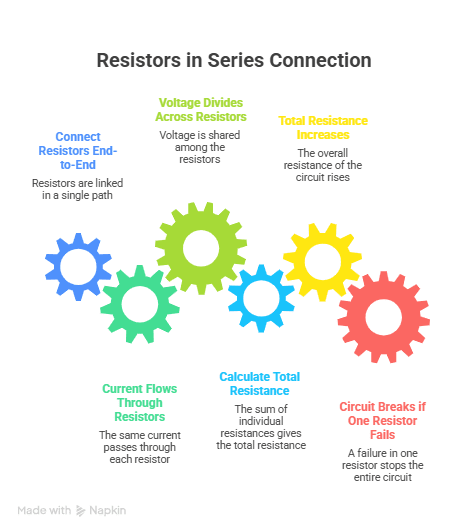
When resistor are connected end-to-end in a single path, they are said to be connected in series.
The same current flows through all resistor, but voltage is shared.
Resistor in Series Formula:
R_total = R1 + R2 + R3 + …
Example:
- R1 = 100Ω, R2 = 200Ω, R3 = 300Ω
- R_total = 100 + 200 + 300 = 600Ω
Key points:
- Total resistance increases in series
- Same current flows through each resistor
- Voltage divides across resistor
- If one resistor fails, the whole circuit breaks
Series connections are used in voltage dividers and current limiting circuits.
Resistors in Parallel
When resistor are connected across the same two points (same voltage), they are in parallel.
Each resistor gets the same voltage, but current divides.
Resistors in Parallel Formula:
1/R_total = 1/R1 + 1/R2 + 1/R3 + …
For two resistor in parallel (quick formula):
R_total = (R1 × R2) / (R1 + R2)
Example:
- R1 = 100Ω, R2 = 100Ω
- R_total = (100 × 100) / (100 + 100) = 10000/200 = 50Ω
Key points:
- Total resistance is always less than the smallest resistor
- Voltage is the same across all resistor
- Current divides based on resistance
- If one resistor fails, others still work
Parallel connections are used in household wiring and power distribution circuits.
Resistor in Series and Parallel (Combination Circuits)
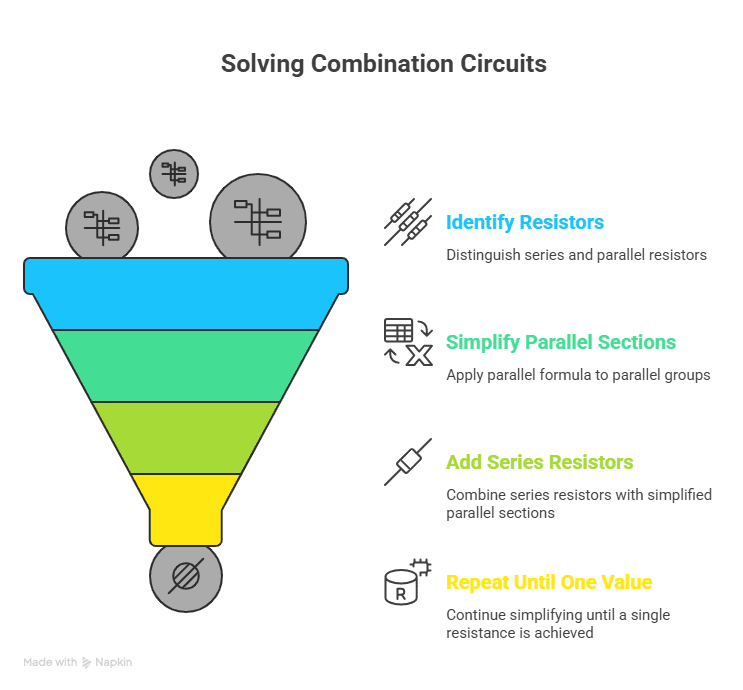
Real circuits often use both series and parallel resistor together. This is called a combination circuit.
How to solve a combination circuit:
- Identify which resistor are in series and which are in parallel
- Simplify the parallel sections first using the parallel formula
- Then add the series resistor
- Repeat until you get one final resistance value
Example:
- R1 = 10Ω (series)
- R2 = 20Ω and R3 = 20Ω (parallel with each other)
Step 1: R2 ∥ R3 = (20×20)/(20+20) = 10Ω
Step 2: R_total = R1 + 10 = 10 + 10 = 20Ω
This concept is taught in class 10 physics (resistor in parallel class 10) and is important for board exams.
How to Choose the Right Resistor for Your Circuit
Choosing the right resistor is easy if you know 3 things:
1. Resistance Value (Ohms)
Use Ohm’s Law to calculate: R = V / I
- Know your supply voltage and desired current
- Pick the nearest standard resistor value (E12 or E24 series)
2. Power Rating (Watts)
Use the formula: P = I² × R or P = V² / R
- Always choose a resistor with at least 2× the calculated power
- Example: If circuit needs 0.1W, use a ¼W (0.25W) resistor
3. Tolerance
- ±1% for precision circuits (e.g., measurement devices)
- ±5% for general purpose circuits (most common)
Quick Decision Guide:
| Situation | Recommended Resistor |
| Breadboard/Prototyping | Through Hole, ¼W, ±5% |
| Final PCB Design | SMD 0805 or 0603 |
| High Power Circuit | Through Hole, 1W or 2W |
| Precision Circuit | Metal Film, ±1% |
| School Project | Carbon Film, Through Hole |
Pro Tip: Always double-check your resistor value with a multimeter before soldering!
Resistor Value & Power Calculator (Interactive Section)
Use these simple formulas to calculate resistor values yourself:
Resistance Calculator (Ohm’s Law):
R = V ÷ I
- V = Voltage (in Volts)
- I = Current (in Amperes)
- R = Resistance (in Ohms)
Example: 9V battery, want 30mA current → R = 9 / 0.030 = 300Ω
Power Dissipation Calculator:
P = V × I or P = I² × R
Example: 300Ω resistor with 30mA → P = (0.030)² × 300 = 0.27W → Use a ½W (0.5W) resistor to be safe
Standard Resistor Values (E12 Series) – Quick Reference:
10, 12, 15, 18, 22, 27, 33, 39, 47, 56, 68, 82 (then ×10, ×100, ×1K, ×10K…)
These are the most commonly available resistor values in the market.
Resistor Images & Visual Learning Guide
Here’s a visual reference to help you identify resistors easily
Through Hole Resistor – What to Look For:
- Cylindrical body with colored bands
- Two metal wire leads on each side
- Usually beige, blue, or green body color
- Color bands read left to right
SMD Resistor – What to Look For:
- Tiny rectangular chip (looks like a flat block)
- Two silver ends for soldering
- Number code printed on top (e.g., “103” = 10kΩ)
- Very small — typically 1–3mm long
Reading SMD Resistor Codes:
| Code | Value |
| 100 | 10Ω |
| 220 | 22Ω |
| 103 | 10,000Ω (10kΩ) |
| 472 | 4,700Ω (4.7kΩ) |
| 0 or 000 | 0Ω (jumper wire) |
The last digit in SMD codes = number of zeros to add.
Resistors Price in India
Resistor are very affordable in India. Here’s a general price guide:
| Type | Quantity | Approx. Price |
| Carbon Film Through Hole (¼W assorted) | 100 pcs | ₹30 – ₹80 |
| Metal Film Through Hole (1% tolerance) | 100 pcs | ₹50 – ₹150 |
| SMD Resistors (0805, assorted kit) | 100 pcs | ₹40 – ₹120 |
| SMD Resistor Kit (0402/0603/0805) | 1000+ pcs | ₹150 – ₹500 |
| High Power Resistor (1W–5W) | Per piece | ₹2 – ₹20 |
| Resistor Assortment Box (mixed values) | 600 pcs | ₹100 – ₹250 |
Prices vary by brand, seller, and quantity. Buying in bulk always reduces the per-unit cost.
Tip: For students and hobbyists, buying an assortment kit (600–1000 pcs) is the most cost-effective option.
Buy Resistors Online
You can easily buy resistor online in India from these platforms
- Amazon India – Wide range, fast delivery, good for small quantities
- Flipkart – Budget options, decent for beginners
- Robu.in – Electronics-focused, good for SMD and specialty resistor
- Electronicscomp.com – Bulk pricing available
- Ktron.in – Good for SMD resistor kits
- Evelta.com – Trusted electronics supplier
What to search when buying:
- “1/4W resistor kit assorted”
- “SMD resistor 0805 kit”
- “metal film resistor 1% 100 pcs”
- “carbon film resistor pack”
Things to check before buying:
- Power rating (¼W, ½W, 1W)
- Tolerance (±1% or ±5%)
- Package type (Through Hole or SMD)
- Quantity per pack
- Seller rating and reviews
- Browse Our Wide Range of Electronic Components Online – Shop with Ease in India Edzeal
What Is an SMD Transistor?
If you’ve ever looked at a modern circuit board and wondered what those tiny little components are — chances are, many of them … Read More SMD transistors.
Want to Know more about resistore click .
Frequently Asked Questions (FAQs)
Q1. Resistors kya hota hai? (What is a resistor in Hindi?) Resistor ek electronic component hai jo circuit mein current ke flow ko control karta hai. Yeh current ko “resist” karta hai — isliye iska naam resistor hai. Isko Ohms (Ω) mein measure kiya jaata hai.
Q2. What is the difference between SMD and Through Hole resistors? SMD resistor are tiny chips used in modern PCBs. Through Hole resistor have wire leads and are used in breadboards and prototyping. Through Hole is easier for beginners; SMD is better for compact designs.
Q3. How do I read a resistor color code? Read the color bands left to right. First two bands = digits, third band = multiplier, fourth band = tolerance. Use the color code table above or the mnemonic “BB ROY of Great Britain has a Very Good Wife.”
Q4. What happens when resistor are connected in series? Total resistance increases. It equals the sum of all resistor: R_total = R1 + R2 + R3. The same current flows through all, but voltage is divided.
Q5. What happens when resistors are connected in parallel? Total resistance decreases. It is always less than the smallest resistor. Voltage stays the same; current divides. Formula: 1/R_total = 1/R1 + 1/R2 + …
Q6. How do I calculate what resistor I need for an LED? Use R = (V_supply – V_LED) / I_LED. For a 5V supply, 2V LED, and 20mA current: R = (5 – 2) / 0.020 = 150Ω. Use the nearest standard value: 150Ω or 180Ω.
Q7. What power rating resistor should I use? Calculate P = I² × R, then choose a resistor with at least double that wattage. For most low-power circuits, a ¼W (0.25W) resistor works fine.
Q8. Where can I buy resistors in India? You can buy resistor from Amazon India, Robu.in, Ktron.in, and Electronicscomp.com. For beginners, an assorted resistor kit (600+ pieces) is the best value for money.
Q9. What does the “k” mean in resistor values like 10kΩ? “k” means kilo, which equals 1,000. So 10kΩ = 10,000 Ohms. Similarly, 1MΩ = 1,000,000 Ohms.
Q10. Can I connect resistor of different values in parallel? Yes, absolutely. Use the formula: 1/R_total = 1/R1 + 1/R2. Or the shortcut for two : R_total = (R1 × R2) / (R1 + R2).
What to read next
-

By EDZEAL | March 6, 2026
What is a Rocker Switch?
A rocker switch is one of the most commonly used electrical switches in the world. You’ll find it on air coolers, hair dryers, power strips, UPS machines, and even car
-
By EDZEAL | February 26, 2026
Types of Capacitors Explained (Comparison-Based)
Not all capacitors are the same. Different jobs need different types. Choosing the wrong one can cause your circuit to fail — or perform poorly. Here’s a clear breakdown of
-
By EDZEAL | February 19, 2026
SMD Transistor Guide: Codes, Markings, BC547/BC847 Equivalents & TL431 vs TL432 Explained
What Is an SMD Transistor ? If you’ve ever looked at a modern circuit board and wondered what those tiny little components are — chances are, many of them are