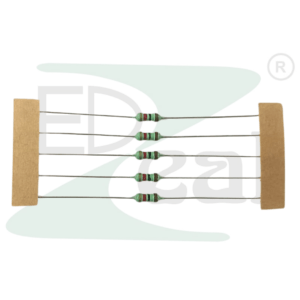
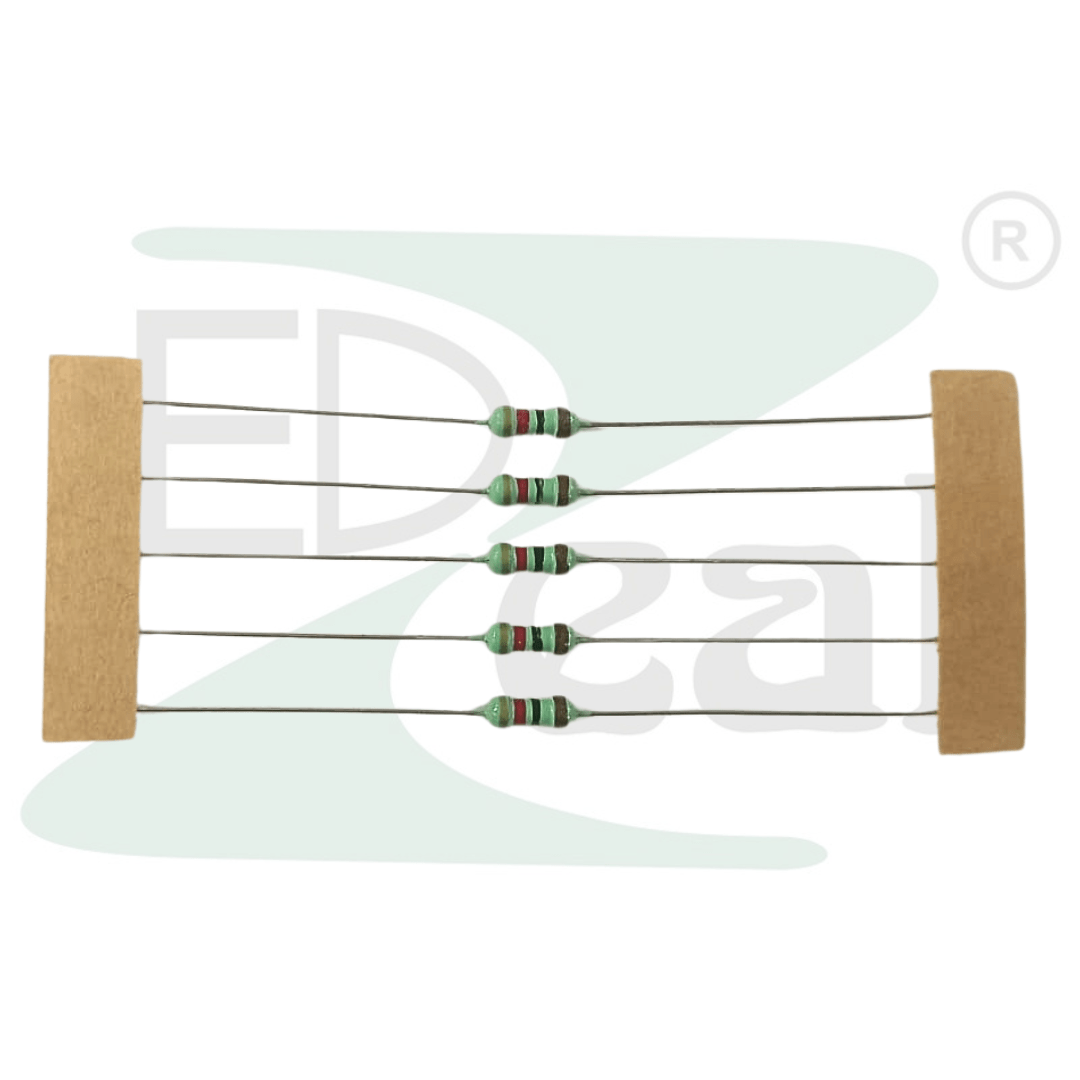
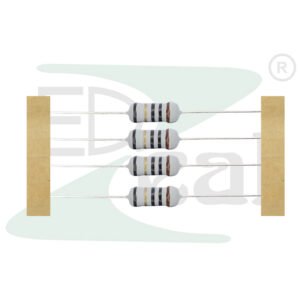
1 OHM ±5% 1/4W Through Hole Resistor — CFR Carbon Film Axial (1R)
The 1 Ohm ±5% 1/4W Through Hole Resistor — commonly referred to as 1R in Indian electronics stores, PCB BOMs, and engineering datasheets — is one of the most electrically unique resistor values in the entire standard series. Unlike the mid-range values used primarily for current limiting in signal circuits, the 1 Ohm resistor operates in a fundamentally different domain: it is an ultra-low-resistance component primarily used for current sensing, shunt measurement, inrush current limiting, power supply protection, and audio amplifier feedback — applications where its near-zero resistance allows high current to flow while still providing a measurable voltage drop for monitoring or control purposes.
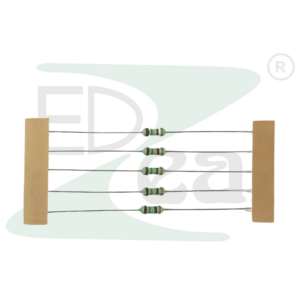
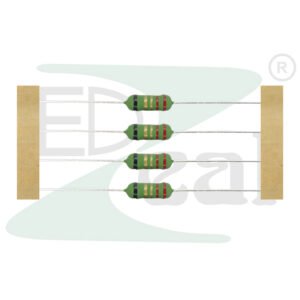
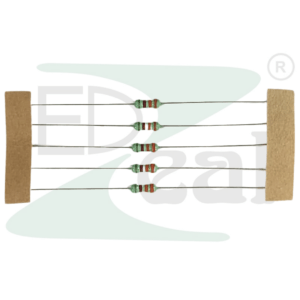
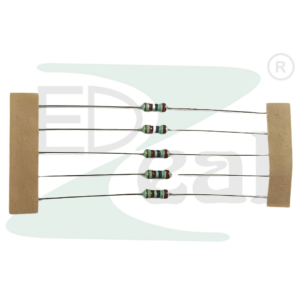
This carbon film resistor features strong leads and easy-to-read color coding for breadboarding, with leads approximately 0.55mm in diameter constructed of tin and copper plated over steel wire, allowing them to stand well with repeated inserts into solderless panels. ProtoSupplies
Whether you are an electronics engineer designing a precision power supply, a student building a current measurement circuit, or a maker prototyping a motor controller — the 1 Ohm resistor is an essential, specialist component that every serious electronics toolkit must stock.
Key Technical Specifications
Resistance Value: 1 Ohm (1Ω / 1R). Tolerance: ±5%. Power Rating: 1/4W (0.25 Watts). Type: CFR — Carbon Film Resistor, Through Hole (THT), Axial Lead. 4-Band Color Code: Brown – Black – Gold – Gold. Maximum Operating Voltage: 350V. Operating Temperature Range: -55°C to +155°C. Temperature Coefficient: 0 / -850 ppm/°C. Lead Diameter: 0.55mm, copper-plated steel (24 AWG). Compliance: RoHS Compliant, Lead-Free.
What Does “1R” Mean? — The Notation Explained
In Indian electronics stores, PCB Bill of Materials documents, and engineering catalogs, this component is frequently listed as 1R rather than “1 Ohm” or “1Ω”. The letter “R” is an IEC 60062 and BS 1852 standard substitution for the Ohm symbol (Ω) — used because the special character Ω cannot always be printed on physical component reels, plain-text BOM files, or legacy CAD systems. For values below 10 Ohms, the “R” is also used as a decimal point placeholder: so 1R0 = 1.0 Ohm, R10 = 0.10 Ohm, and 1R = 1 Ohm. Understanding this notation is essential when reading Indian and UK-standard PCB BOMs, component supplier catalogs, and industry schematics where all three forms appear interchangeably.
Color Code — Fully Decoded
The standard 4-band color code for the 1 Ohm ±5% resistor is Brown – Black – Gold – Gold. Reading left to right: Brown represents the first significant digit (1), Black represents the second significant digit (0), together forming the base number 10. The Gold multiplier band represents ×0.1. Multiplying 10 by 0.1 gives exactly 1 Ohm. The final Gold tolerance band confirms ±5% accuracy. Electronics Pices
This means any individual unit will measure between 0.95 Ohms and 1.05 Ohms — within specification for current sensing, shunt, and protective resistor applications where the small resistance drop is critical but high precision is not mandatory. For precision current sensing requiring tighter tolerances (±1% or ±0.5%), a metal film 1 Ohm resistor is recommended.
Critical identification note: The 1 Ohm resistor is one of the few standard values where the multiplier band is Gold (×0.1) — not Brown or Black. This makes it visually distinctive from most resistors in a typical component drawer, but also means it can be confused with tolerance bands. Always read from the end closest to a lead — the first Brown band will always be at the lead end, never the Gold band. When uncertain, confirm with a multimeter set to the lowest resistance range (200Ω or less).
Applications — Where the 1 Ohm Resistor Is Used
The 1 Ohm through-hole resistor serves a unique set of applications that no other resistor value handles in quite the same way. It is not primarily a current-limiting resistor — it is a precision sensing, protection, and feedback component for circuits where both high current flow and low voltage drop are simultaneously required.
In power supply circuits, particularly where higher currents are expected, 1 Ohm resistors are used for current sensing and protection — allowing monitoring of circuit current to ensure safe operating parameters through a feedback loop that reduces output voltage when current through the load exceeds safe limits. Electronics Pices
The 1 Ohm resistor is often used as a current sense resistor (shunt) to measure current flow or to simulate a specific load. In power supplies, it can also act to simulate the ESR (Equivalent Series Resistance) of a large capacitor. Amazon
In audio equipment, 1 Ohm resistors are used in amplifier circuits as shunt resistors for current feedback, providing stability and controlling the gain to improve sound quality, ensuring that the current is regulated and does not damage the speaker. Electronics Pices
Within automotive electronics, 1 Ohm resistors are used in diverse electronic control systems such as engine control units (ECU), anti-lock braking systems (ABS), and lighting systems. Electronics Pices
Full list of proven applications: current sensing and shunt measurement circuits, inrush current limiting in power supply startup circuits, power supply overcurrent protection and feedback loops, motor controller current monitoring circuits, battery management system (BMS) current sensing networks, Class AB audio amplifier bias and feedback stabilization, speaker crossover networks and voice coil protection, ESR simulation for large electrolytic capacitors in test circuits, automotive ECU, ABS, and lighting protection circuits, Arduino and Raspberry Pi motor driver current sensing, low-value resistance reference in bridge measurement circuits, fuse replacement in low-current protection applications, and RC snubber network damping resistors.
Why This Is Not a Standard Current-Limiting Resistor — And Why That Matters
Most resistors in a typical electronics toolkit — 220 Ohm, 470 Ohm, 1K, 10K — are used to limit current flowing through LEDs, transistors, and GPIO pins. The 1 Ohm resistor works on an entirely different principle. Because its resistance is so low, it does not significantly impede current flow — which is precisely the point. When a circuit uses a 1 Ohm shunt resistor, it can measure the voltage across it (using Ohm’s Law: V = I × 1Ω, so Voltage in millivolts = Current in milliamps numerically) and use that measurement to determine how much current is flowing. This makes the 1 Ohm resistor an extremely powerful and inexpensive current monitoring tool in power electronics, motor control, and battery management systems.
Safe Operating Guidelines — Critical for 1 Ohm Applications
The 1/4W (0.25W) power rating is particularly important to understand for a 1 Ohm resistor, because the power dissipation at low resistance values can be very high for even modest currents. Using the formula P = I² × R: at 100mA (0.1A), the dissipation is (0.1)² × 1 = 0.01W — well within limit. At 300mA (0.3A), it is (0.3)² × 1 = 0.09W — approaching the safe 50% derating threshold. At 500mA (0.5A), dissipation is (0.5)² × 1 = 0.25W — at the absolute rated limit and should never be sustained continuously.
Maximum safe continuous current for this 1/4W, 1 Ohm resistor: 500mA at full rating, 350mA at the recommended 50% derating level. For circuits expecting continuous currents above 500mA through a 1 Ohm shunt, always upgrade to a 1W, 2W, or 5W 1 Ohm resistor. This derating principle is critical — failing to observe it in shunt/sensing applications where current can spike is the primary cause of resistor failure in power circuits.
Frequently Asked Questions — Answered
What is the color code of a 1 Ohm resistor? The 4-band color code is Brown, Black, Gold, Gold. Brown (1) and Black (0) form the base number 10. Gold multiplier (×0.1) gives 1.0 Ohm. Final Gold band = ±5% tolerance.
What is the difference between 1 Ohm resistor and a 1K Ohm resistor? A 1K Ohm resistor is 1,000 times more resistance than a 1 Ohm resistor. The 1K Ohm is used for LED current limiting and GPIO protection. The 1 Ohm is used for current sensing and shunt measurement in power and motor circuits.
What is a 1R resistor used for? Current sensing/shunt measurement, inrush current limiting, power supply overcurrent protection, audio amplifier feedback stabilization, motor driver current monitoring, BMS current sensing, and automotive ECU protection circuits.
What does 1R mean on a resistor? “1R” is an IEC 60062 standard notation where “R” replaces the Ohm symbol (Ω). 1R = 1 Ohm. In values below 10, “R” also serves as a decimal point placeholder (e.g., 4R7 = 4.7 Ohm, R47 = 0.47 Ohm).
Can I use a 1 Ohm 1/4W resistor for current sensing at 500mA? At the absolute limit — yes, but not recommended for continuous duty. At 500mA continuous, the resistor dissipates exactly 0.25W (the rated limit). Best practice is to stay at or below 350mA for continuous operation (50% derating) or upgrade to a 1W or 2W rated 1 Ohm resistor for sustained high-current sensing.
Is this resistor RoHS and lead-free compliant? Yes — fully RoHS compliant and manufactured lead-free.



There are no reviews yet.