What is a Rocker Switch?
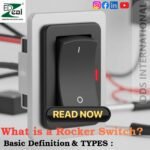
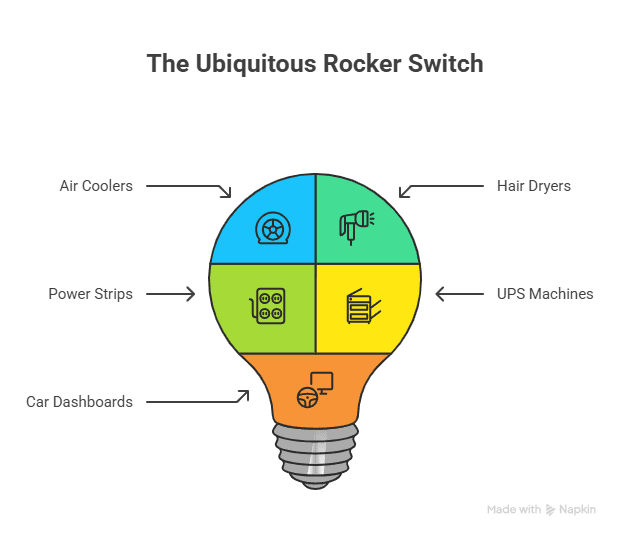
A rocker switch is one of the most commonly used electrical switches in the world. You’ll find it on air coolers, hair dryers, power strips, UPS machines, and even car dashboards. Yet most people don’t know what it’s actually called — they just press it every day without a second thought.
Using a rocker in your devices can enhance usability and control.
Rocker are favored for their reliability in both household and industrial applications.
Many people rely on a rocker switch for controlling household devices, making it an essential part of modern electrical systems.
So let’s break it down simply and clearly.
Examples of switch installations are everywhere, from kitchen appliances to automotive applications.
The Basic Definition
Understanding a rocker is crucial for anyone working with electrical appliances.
A rocker is an electrical switch that works on a pivot mechanism. It has a flat or slightly curved actuator — the part you press — that “rocks” from one side to the other, just like a seesaw.
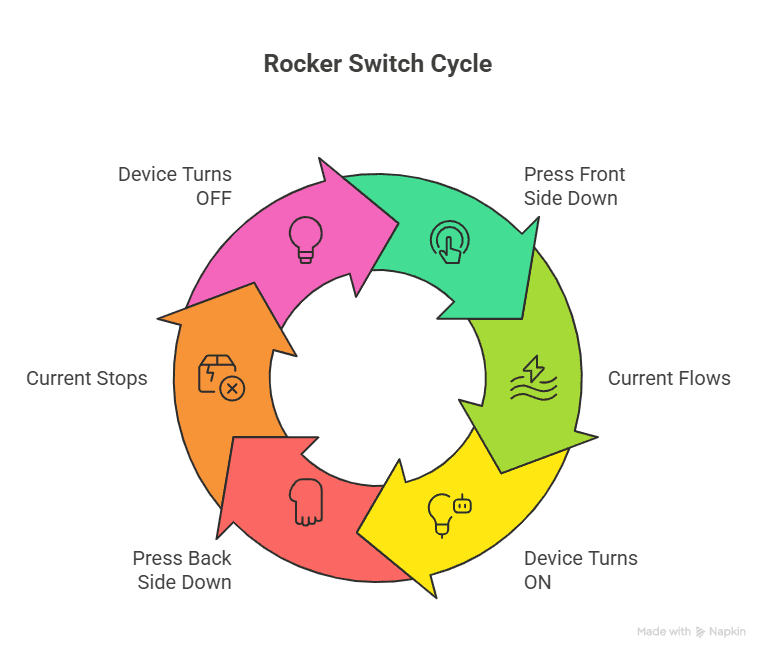
- Press the front side down → the circuit completes → current flows → device turns ON
- Press the back side down → the circuit breaks → current stops → device turns OFF
This back-and-forth rocking motion is exactly where the name comes from.
The core job of any rocker switch is simple: control the flow of electricity between two points.
The rocker design allows for easy operation, making it ideal for various devices.
A rocker can be found in most households, often unnoticed but frequently used.
Unlike complex electronic components, the rocker does one thing — and it does it extremely reliably.
TYPES :
- Rocker Cooler Switch Black 2 Pin On Off Copper
- Rocker Cooler Switch Black 3 Pin 3 Way Copper
- Rocker Cooler Switch Green Light 3 Pin On Off Copper
- Rocker Cooler Switch Green Light 3 Pin On Off Iron
- Rocker Cooler Switch Red 3 Pin 3 Way Copper
- Rocker Cooler Switch Red Light 3 Pin On Off Iron
- Rocker Double Cooler Switch Black 6 Pin On Off Iron
- Rocker Double Cooler Switch Red Green Light 6 Pin On Off
Why Is It Called a “Rocker” Switch?
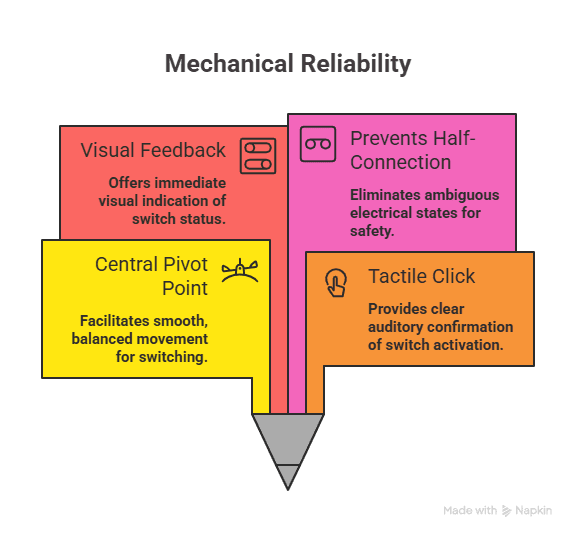
The name is purely mechanical. Inside the switch body, there is a central pivot point — like the fulcrum of a seesaw. When you press one end of the switch down, the other end rises up automatically.
This pivot-based movement:
- Creates a clear, tactile click when switching
- Gives you instant visual feedback — one end is always visibly raised
- Prevents the switch from staying in a half-connected, uncertain position
This is what makes rocker safer and more reliable than many other switch types in everyday appliances.
How Is a Rocker Switch Different from Other Switches?
This is one of the most common questions people have — and it’s a fair one, because there are many types of switches in electrical systems.
When choosing a rocker, consider its durability and application suitability.
Here’s a simple side-by-side comparison:
Rocker Switch vs Toggle Switch
| Feature | Rocker Switch | Toggle Switch |
| Actuator Type | Flat, rocking plate | Lever / bat handle |
| Operation | Side-to-side rocking | Up-and-down flip |
| Panel Mount | Flush with the panel | Protrudes outward |
| Visual Feedback | Easy to see ON/OFF | Lever position shows state |
| Common Use | Appliances, dashboards | Industrial, older equipment |
The rocker switch 3 pin sits flush against the panel surface, making it sleeker and more modern than the toggle switch.
Toggle switches are still used in industrial and older equipment, but for consumer appliances and modern electronics, rocker have largely taken over.
Rocker Switch vs Push Button Switch
| Feature | Rocker Switch | Push Button Switch |
| Motion | Rocks side to side | Pushes straight in |
| Latching | Stays in position | May or may not latch |
| ON/OFF Clarity | Very clear | Depends on type |
| Common Use | ON/OFF appliance control | Momentary or reset functions |
A push button switch is often used for momentary actions — like a doorbell or a reset button. A rocker, on the other hand, stays in the ON or OFF position until you physically press it again.
This is why rocker are preferred for appliances that need to stay ON for a long time — like coolers, fans, or power supplies.
Rocker Switch vs Slide Switch
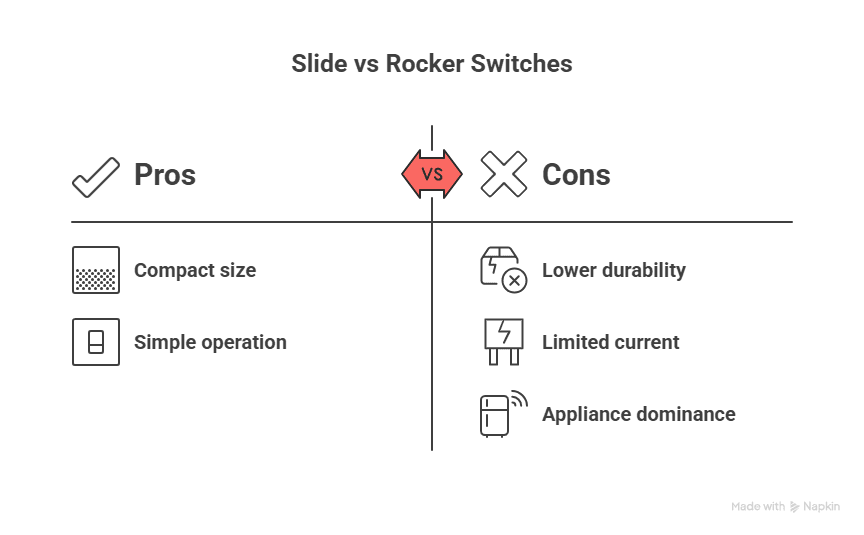
A slide switch moves horizontally — you push a small tab left or right. It works similarly to a rocker in terms of ON/OFF function, but:
- Slide switches are smaller and less durable for heavy loads
- Rocker can handle higher current ratings, such as a rocker switch 6 pin 16 amp version used in power strips and UPS units
- Slide switches are common in small electronics; rocker dominate in appliances
TYPES :
- Rocker Double Cooler Switch Red Green Without Light 4 Pin On Off
- Rocker Double Cooler Switch Red Light 6 Pin On Off
- Rocker Double Cooler Switch Red Light 6 Pin On Off Copper
- Rocker Oval Switch Black 2 Pin On Off Copper
- Rocker Oval Switch Black 3 Pin 3 Way Copper
- Rocker Oval Switch Black 3 Pin On Off Copper
- Rocker Oval Switch Black Red 2 Pin On Off Copper
- Rocker Round Mini Switch Black 2 Pin On Off Copper 14mm
- Rocker Round Mini Switch Black Red 2 Pin On Off Copper 14mm
- Rocker Round Switch Black 2 Pin On Off Copper
- Rocker Round Switch Black 2 Pin On Off Iron
- Rocker Round Switch Black 3 Pin 3 Way Copper
- Rocker Round Switch Black Red 2 Pin On Off Copper
- Rocker Round Switch Black Red 3 Pin 3 Way Copper
- Rocker Round Switch Red Light 3 Pin On Off Copper
- Rocker Round Switch Red Light 3 Pin On Off Iron
The Anatomy of a Rocker Switch
To truly understand a rocker , it helps to know what’s inside it.
1. Actuator (the part you press)
This is the visible rocking plate on the outside. It can be:
- Flat or slightly curved
- Round, oval, or rectangular in shape — for example, a rocker switch 6 pin round style is common in compact appliance panels
- Plain or marked with ON/OFF, I/O, or symbols
2. Pivot Mechanism
Hidden inside the switch body, this central pivot is what allows the actuator to rock. It ensures one side is always pressed down while the other rises.
3. Internal Contacts
These are the metal pieces that make or break the electrical connection. They come in two material types:
- Copper contacts — better conductivity, lower resistance, longer lifespan, preferred for higher-quality switches
- Iron contacts — lower cost, adequate for basic applications, slightly more prone to oxidation over time
The contact material directly affects the performance and durability of the switch, which is why you’ll often see product names specify “copper” or “iron” when shopping.
4. Terminal Pins
These are the metal pins at the back of the switch that connect to your wiring. The number of pins determines the type of switch:
- 2 pin — basic ON/OFF
- 3 pin — ON/OFF with LED indicator or 3-way control
- 4 pin — double pole or reset function
- 6 pin — 3-way or centre-off configurations
The rocker switch connector — meaning the pin layout and terminal design — is one of the most important things to check before buying or wiring a switch.
5. Housing / Body
The outer casing that holds everything together. Usually made from:
- ABS plastic (common in standard switches)
- Nylon or polycarbonate (for heat-resistant versions)
- Available in multiple colors — black, red, white, grey, and more
6. LED Indicator (in some models)
Some rocker include a small built-in LED light inside the actuator. A rocker switch 4 pins with LED indicator glows when the switch is in the ON position, giving a clear visual signal — especially useful in low-light environments or for safety-critical appliances.
What Are the Common Electrical Uses of a Rocker Switch?
Rocker switches 4 pins are incredibly versatile. They are used across:
Home Appliances
- Air coolers — controlling fan speed and pump
- Hair dryers — the classic rocker switch 2 pin hair dryer configuration
- Electric irons — simple ON/OFF control
- Table fans and ceiling fan controllers
Power & Electrical Equipment
- UPS systems — often using a rocker switch 4 pin or a rocker switch 6 pin 16 amp rated model for safe high-current switching
- Power strips and extension boards
- Inverters and battery chargers
Automotive & Marine
- Car dashboard switches — often using compact round or oval rocker styles
- Boat control panels — marine-grade rocker switches 3 pin for pumps and lights
- Trucks and heavy vehicles
Industrial Applications
For those looking to upgrade their equipment, consider using a rocker switch 2 pin for better functionality.
- Control panels — using multi-pin configurations like rocker switch 6 pin for 3-way and centre-off control
- Machinery ON/OFF controls
- Test and measurement equipment
Commercial Products
- Point-of-sale terminals
- Vending machines
- Medical equipment panels
Because of this wide range of uses, rocker switches are available in dozens of variants — different sizes, pin counts, current ratings, shapes, and colors.
Rocker Switch Ratings — What the Numbers Mean
Every rocker switch comes with electrical ratings. These tell you the maximum voltage and current it can safely handle.
Common ratings you’ll see:
- 6A / 250V — for light-duty appliances like small fans
- 10A / 250V — mid-range appliances
- 16A / 250V — heavy-duty use; a rocker switch 16 amp is used in power strips, UPS, and industrial panels
Using a switch with a rating lower than what your appliance needs can cause overheating, arcing, or fire. Always match the switch rating to your load.
Rocker Switch in the Indian Market — HSN Code & GST
For businesses, importers, and exporters in India, every electrical component needs proper classification.
The rocker switch HSN code falls under the broader category of electrical switches and switching apparatus. The applicable HSN code is typically 8536 — covering switches for voltages not exceeding 1,000V.
- GST rate applicable: 18% in most cases
- Used in invoicing, import/export documentation, and e-way bills
If you’re buying in bulk or sourcing from manufacturers, always verify the exact HSN sub-code with your CA or the GST portal, as it can vary based on switch type and application.
Learn More About Switch tap .
Where to Buy Rocker Switches?
Rocker switches are widely available across multiple channels:
- Online marketplaces — searching for a rocker switch 4 pin on Amazon will give you hundreds of options across pin types, shapes, and current ratings; great for retail buyers or small quantities
- Electrical wholesale markets — ideal for bulk procurement at lower per-unit prices
- Direct from manufacturers — best for OEM buyers, custom specifications, and large volumes
- Electrical hardware stores — for quick local sourcing
When buying, always check: pin configuration, current rating, contact material (copper or iron), LED or non-LED, and body color.
- Best Rocker switch manufacturers in india : Edzeal & DDS International
Quick Summary
Let’s recap everything in simple terms:
- A rocker switch 4 pin is a pivot-based ON/OFF switch that rocks between two positions
- It is different from toggle and push-button switches in design, feel, and application
- It consists of an actuator, pivot, contacts, terminal pins, and housing
- Available in 2, 3, 4, and 6 pin configurations for different functions
- Comes in round, oval, rectangular, and cooler-specific shapes
- Used in air coolers, hair dryers, UPS, power strips, dashboards, and industrial panels
- Rated for currents up to 16 amps for heavy-duty applications
- Classified under HSN code 8536 for GST purposes in India
- Available online and offline, for both retail and bulk buyers
The versatility of a rocker switch 2 pin means it can be used in various settings, enhancing user accessibility.
Many people are unaware that a rocker switch 3 pin can offer both aesthetic appeal and functionality.
In commercial settings, a rocker switch 4 pin is preferred for its reliability and ease of use.
Educating consumers about the rocker switch 6 pin is essential for promoting safe electrical practices.
What to read next
-

By EDZEAL | February 26, 2026
Types of Capacitors Explained (Comparison-Based)
Not all capacitors are the same. Different jobs need different types. Choosing the wrong one can cause your circuit to fail — or perform poorly. Here’s a clear breakdown of
-
By EDZEAL | February 19, 2026
SMD Transistor Guide: Codes, Markings, BC547/BC847 Equivalents & TL431 vs TL432 Explained
What Is an SMD Transistor ? If you’ve ever looked at a modern circuit board and wondered what those tiny little components are — chances are, many of them are
-
By EDZEAL | November 17, 2025
How to Maintain Component Quality During Long-Term Storage
For OEMs, manufacturers, and industrial buyers, maintaining the quality of electronic components during long-term storage is crucial. Components like capacitors, resistors, connectors, ICs, switches, and transistors can degrade over time if not stored under proper conditions. This affects production reliability, product performance, and overall cost efficiency