
Potentiometer Explained: Uses, Types, Cost & Buying Guide for OEM Buyers

You have turned a volume knob. You have adjusted a fan speed. You have dimmed a light in your room.
Every single time you did that — a potentiometer was doing the work.
Most people have never heard the word. But this tiny component is inside thousands of devices you use every single day. It is one of the most important parts in electronics, and yet it rarely gets the attention it deserves.
If you are an engineer sourcing components, an OEM buyer comparing suppliers, or simply someone trying to understand what this part actually does — you are in the right place.
This guide explains everything about potentiometers in plain, simple language. No confusing technical terms. No unnecessary jargon. Just clear, practical information that helps you make smarter decisions.
So, What Exactly Is a Potentiometer?
A potentiometer is an electronic component that controls resistance in a circuit.
Think of it like a water tap. When you open the tap fully, water flows fast. When you close it halfway, the flow slows down. A potentiometer does the same thing — but with electricity instead of water.
Here is what happens inside:
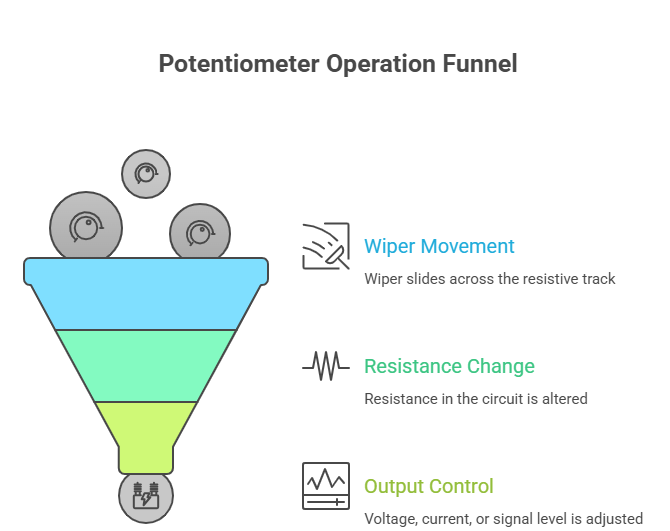
- You turn the knob or move the slider
- The wiper moves across a resistive track
- Resistance in the circuit changes
- This controls the voltage, current, or signal level at the output
That is the potentiometer principle in its simplest form — resistance changes as the wiper moves.
The component has three terminals:
- Terminal 1 & 2 — Fixed at either end of the resistive track
- Terminal 3 (Wiper) — Moves between the two ends to vary output voltage
As the wiper moves, it divides the voltage across the track. This is called voltage division — the core idea behind every potentiometer ever made.
Where Are Potentiometers Actually Used?
This is where it gets interesting. Potentiometer uses span across almost every major industry. Here is a quick look:
In Audio Equipment
- Controls volume levels in speakers and amplifiers
- Used as a potentiometer for volume control in mixers and home theatre systems
- Adjusts tone, bass, and treble settings
- The knob you turn on your speaker — that is a potentiometer doing its job
In Automotive Electronics
- Dashboard controls and display brightness
- Sensor signal regulation
- Lighting level adjustment inside vehicles
In Industrial Machines
- Motor speed control on factory floors
- CNC machine calibration
- Precision adjustment in heavy equipment
- Buyers here often need a potentiometer high range — built for tougher electrical loads
In Medical Devices
- Patient monitoring equipment calibration
- Precision output adjustment in diagnostic tools
- Any system where small errors in output carry real consequences
In Consumer Electronics
- Televisions and remote-controlled devices
- Gaming controllers
- Home appliances like washing machines and microwaves
Bottom line: If a device needs variable control over electricity — there is a very good chance a potentiometer is inside it.

Types of Potentiometers — Which One Do You Need?
Not all potentiometers are the same. Choosing the wrong type for your application is a common and costly mistake.
Rotary Potentiometer
- Most widely used type
- Uses a rotating shaft or potentiometer knob
- Found in audio equipment, fan regulators, and control panels
- Best for applications where circular adjustment feels natural
Slider Potentiometer
- Moves in a straight line instead of rotating
- Common in audio mixing boards and studio equipment
- Gives a more visual, hands-on control experience
Digital Potentiometer
- Controlled electronically — no physical movement needed
- Used in smart devices, automation systems, and IoT applications
- Allows precise, programmable resistance control
Linear vs Logarithmic — What Is the Difference?
| Type | How It Works | Best For |
|---|---|---|
| Linear | Resistance changes at a constant rate | Industrial, measurement, calibration |
| Logarithmic | Resistance changes in a curve | Audio equipment, volume control |
Human ears perceive sound logarithmically — so for audio use, always choose logarithmic. For everything else, linear works best.
How to Choose the Right Potentiometer
This section matters most if you are buying in bulk or specifying components for a product line. Here is a simple buyer checklist:
Step 1 — Pick the Right Resistance Value
- Potentiometer 10k (10,000 ohms) is the most popular and versatile choice
- Works well for general-purpose circuits, signal control, and most OEM applications
- For more sensitive systems — consider 1K or 100K
- For heavy-duty industrial use — you may need high-range values beyond 100K
Step 2 — Check Shaft and Mounting Style
- Panel mount — for front-facing controls on equipment
- PCB mount — for direct integration on circuit boards
- Knob size — make sure the potentiometer knob matches your housing design
- Getting this wrong means redesigning your enclosure — a costly mistake
Step 3 — Match Build Quality to Environment
- Will it face heat or high temperatures? Choose industrial-grade
- Operating in dusty or outdoor conditions? Look for sealed or IP-rated models
- High-cycle usage? Check lifespan ratings in the datasheet carefully
Step 4 — Always Read the Potentiometer Datasheet
Key specs to check:
- Resistance value and tolerance — how accurate is it?
- Power rating — how much load can it handle?
- Rotation angle — full 270°or limited?
- Lifespan in cycles — how long will it last in your application?
- Operating temperature range — critical for industrial and automotive use
For OEM buyers, the potentiometer datasheet is not optional reading — it is the foundation of every smart procurement decision.
What Does a Potentiometer Cost in India?
Potentiometer cost depends on several factors. Here is a simple breakdown:
Factors That Affect Potentiometer Price
- Material quality — carbon vs cermet vs wire-wound resistive tracks
- Tolerance and precision — tighter tolerance means higher price
- Brand and origin — imported vs Indian-manufactured
- Type — digital potentiometers cost more than basic rotary types
- Order quantity — bulk orders always bring the price down
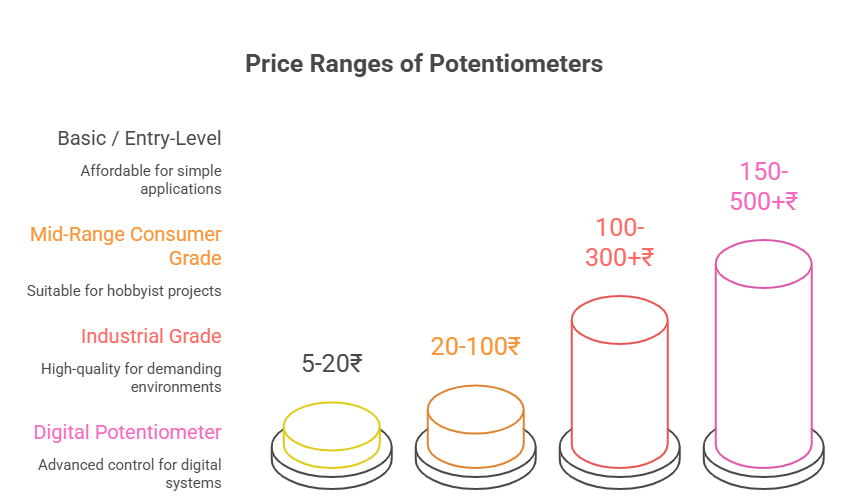
General Price Ranges
| Category | Price Per Piece (Approx.) |
|---|---|
| Basic / Entry-Level | ₹5 – ₹20 |
| Mid-Range Consumer Grade | ₹20 – ₹100 |
| Industrial Grade | ₹100 – ₹300+ |
| Digital Potentiometer | ₹150 – ₹500+ |
Bulk Pricing vs Retail Pricing
- Retail buyers pay per-piece market rates — higher cost, smaller quantities
- OEM and bulk buyers get significantly lower per-piece pricing
- MOQ (Minimum Order Quantity) terms vary by supplier
- Always ask for a formal quotation with datasheet, MOQ, and delivery timelines included
Imported vs Indian Manufacturing
- Imported components may offer tighter tolerances
- Indian-manufactured options are increasingly competitive
- Local sourcing means faster delivery, easier returns, and better after-sales support
To Learn More About Potentiometer Visit Wikipedia
Final Word
A potentiometer is a small component — but it carries a lot of responsibility inside any circuit.
Here is what to remember before you buy:
- Know your resistance value — potentiometer 10k covers most applications
- Match the type to the use — rotary, slider, or digital
- Check the datasheet — never skip this step
- Buy in bulk when possible — the potentiometer price drops significantly at volume
- Choose a supplier with OEM support — not just a box-shipper
FAQ
1. What is a potentiometer?
A potentiometer is an electronic component that controls voltage and resistance in an electrical circuit. It is commonly used in devices where adjustable control is needed, such as volume knobs, dimmer switches, and industrial equipment.
2. How does a potentiometer work?
A potentiometer works by moving a wiper across a resistive track. This movement changes the resistance and adjusts the output voltage in the circuit.
Vout=Vin×R1+R2R2
3. What are the different types of potentiometers?
There are several types of potentiometers available, including:
- Rotary Potentiometer
- Linear Potentiometer
- Digital Potentiometer
- Multi-turn Potentiometer
- Slide Potentiometer
Each type is designed for different electronic and industrial applications.
4. What are the uses of a potentiometer?
Potentiometers are used in many electronic and industrial devices, such as:
- Audio systems for volume control
- Fan speed regulators
- LED light dimmers
- Industrial automation systems
- Measuring instruments
- Automotive electronics
5. What is the difference between a potentiometer and a resistor?
A resistor provides fixed resistance, while a potentiometer offers adjustable resistance. Potentiometers are mainly used where variable control is required.
What to read next
-

By EDZEAL | June 6, 2026
Mylar Speakers 40mm Magnet, 29mm & 27mm Magnet – Complete Buying Guide
What Are Mylar Speakers? What Is a Mylar Speaker? A mylar speaker is a small, lightweight speaker that uses a thin plastic film — called Mylar — as its diaphragm.
-

By EDZEAL | May 30, 2026
Zener Diode vs Normal Diode: Which One is Better for Electronics?
When you build an electronic circuit, every component matters. Choosing the wrong diode can damage your circuit or make it stop working altogether. Two diodes often cause confusion — the
-

By EDZEAL | May 18, 2026
What is a Glass Fuse Small & Fuse Holder? Types, Uses, Sizes & Buying Guide
What is a Glass Fuse Small? A small glass fuse is a tiny safety device used in electronic circuits. It protects your device from too much current flowing through it.